Finding Fun

Because writing a novel is hard and takes a long time, it’s nice to be able to step aside for a while and write something else, especially something relatively quick and personal.

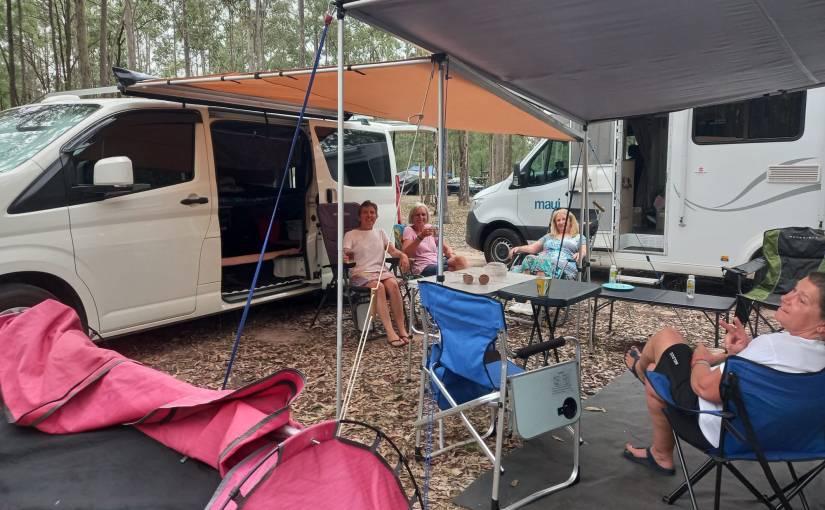
I have a little story here that I recently wrote and had published in the Society of Women Writers’ magazine, Women’s Ink, for their 100th year anniversary. It’s a story about a recent adventure I had with a bunch of women friends. They pushed me outside my comfort zone and taught me that the campervan life was a lot of good fun. So, here’s the story and I hope you enjoy it.

Finding Fun

Listening to the rain as I lie in the dark, I ask myself if this is fun. I’m dry. I’m warm. Actually, I’m quite cosy. But the noise of water on metal is loud and the boxy motorhome is shuddering. A clunk reminds me that I’m camped in a forest of gum trees, tall and spindly things, young and limber. Not widow-makers, fortunately. I wonder how my gutsy friend is coping in the swag. Is she still dry? Is she safe? Should I get up and go out, bring her inside to sleep on my floor? Would she already have crept inside one of the other girls’ vans since we’re all parked together in a commune-like square? We’re in this together, I remember one declaring before we left the last camp, a spontaneous and abrupt decision as another read the weather report. Shithouse weather approaching, the BOM said. We should go, Wonder Woman said. Waiting til tomorrow would mean setting up in the storm and possibly getting bogged. They all agreed. But, but… I said, panicking because that wasn’t the plan and my mind isn’t pliable. I’d been thinking a cup of tea would be nice, and then perhaps a stroll on Jimmy’s beach… Later, I was told with much hilarity that I looked like a stunned mullet.

The corners of my mouth turn up. I stare at the shadow of carpet-lined ceiling and recall my friends leaping into action, jollying me along as the newest member of the group. As the novice – the princess in the rented, oversized, Maui – I got a lot of encouragement. Once they had packed up their compact, perfectly fitted-out campers they assisted me with mine, cooing over the toilet and shower, the electronic bed, the three-burner cooktop, and laughing as they guided me to empty the toilet cassette and unhook the grey-water hosepipe. They were supportive and enthusiastic, and determined that we would be well set up for the Xavier Rudd concert in the Hunter Valley the next night.

I climb down the ladder from my elevated nest. I lift the blind and peer out, see nothing but phantom shapes. The white vans glow grey, their awnings slicing the dark. The swag looks ominous – a long, black, indiscernible body. Apart from the shivering trees and the falling of exhausted leaves, there is no other movement. I can’t see the rain. I can’t see my friends. I can’t see any reason to go out into the eerie and wet world. I use the luxurious toilet, then climb back up to bed.

Curling up on my side I think of my gum boots, the mud, and the other competent campers who decided to setup on the grounds early. The rain started on nightfall, just as predicted. My gang are a clever bunch. I feel smug that I’m with them. They taught me to play a card game yesterday, the first in my life. It challenged me and made me happy. I pull up the doona, snuggle in and smile. Yes, this is fun.
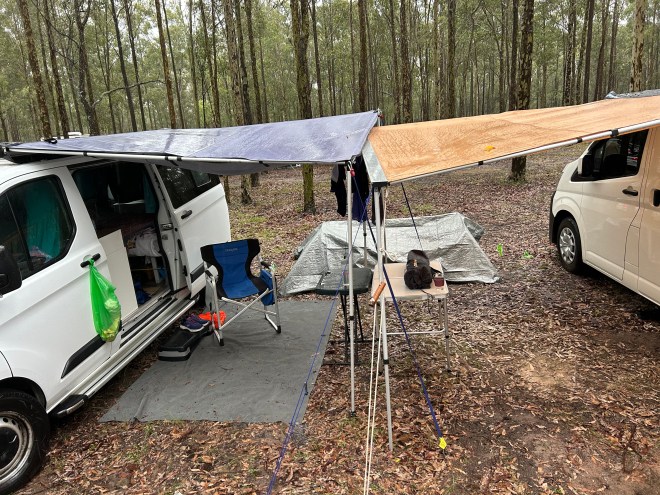
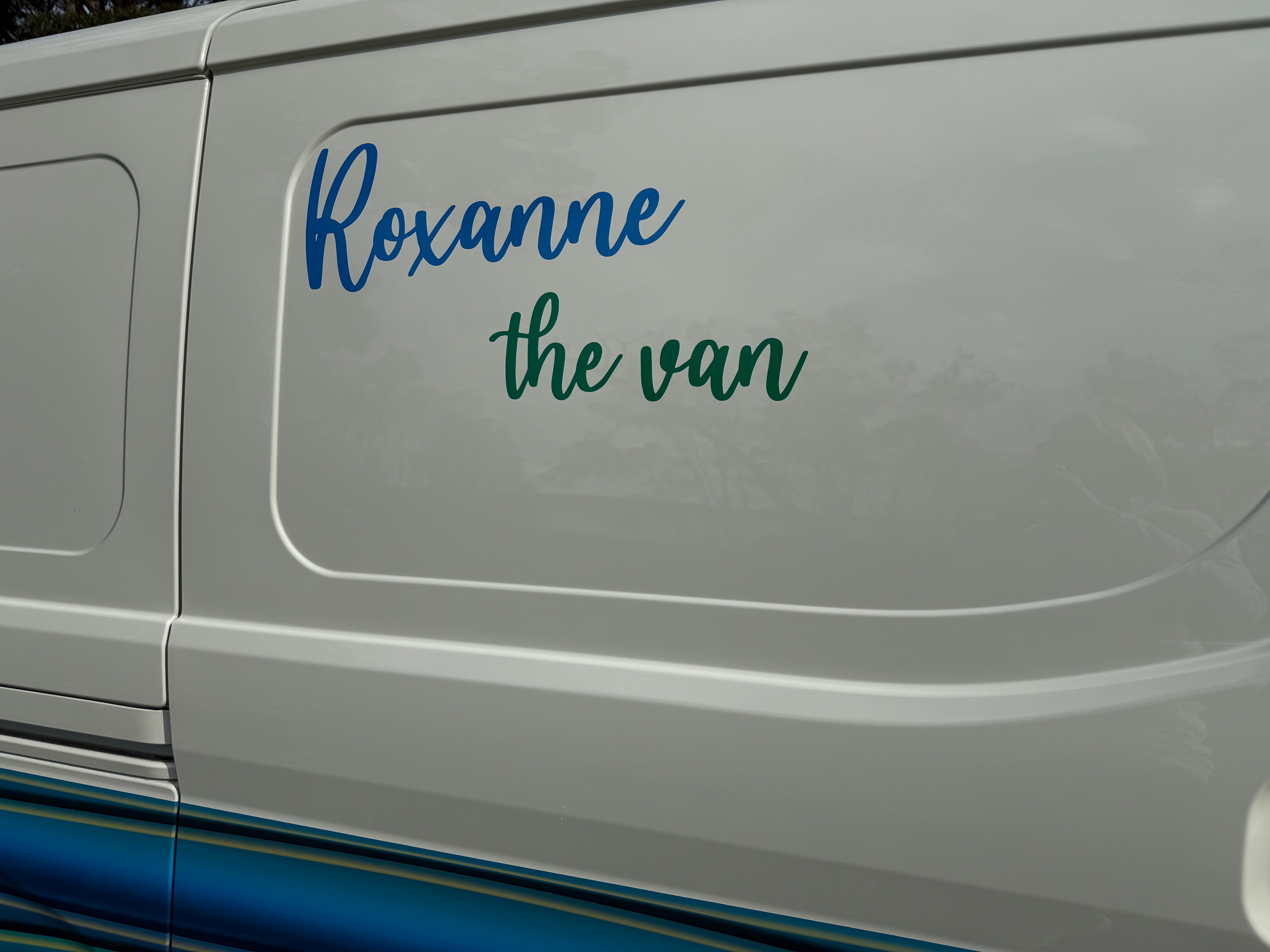
I had so much fun on this trip, I ended up getting my own campervan, a Toyota HiAce I had fitted out myself and called Roxanne. I’m looking forward to more adventures with my friends, fun times I’ll be sure to write about.

How have you found new ways to have fun in the various stages of your life?
Letting Go and Liberation

The Decision to Discontinue the Pursuit of a Publisher

In my last blog, I expressed the quandary I was in about my novel; cut it to fit the requirements of current traditional publishers of contemporary women’s fiction or do it my way and alone. I concluded that I would do a tighter rewrite but wouldn’t alter my story. Therefore, I would self-publish if necessary.

Since I decided that, I have felt a rush of enthusiasm for my work. I feel invigorated, inspired, motivated, and most of all, liberated. All that, despite previously feeling like I’d had enough.

I believe the key to this change of heart was the decision to let go.

Originally, I had no interest in publishing my story. I just wanted to write it, improve on it, improve on it again, and print it for family and friends. The achievement was enough.

Somewhere over the eight years, though, mixing with other writers and published authors, I fell into the trap of wanting more. I wanted SUCCESS. As my manuscript got better, I hoped a well-respected publisher would tell me my work was good enough to put money on, that I was a good writer, that all my effort was worth it because my book would be loved.

To achieve this, I was willing to make adjustments until I reached the goal. Perfectionist traits spiked and fear of failure set in. My own value got more and more entangled in the process. The desire to succeed became a need.

It wasn’t until my last manuscript assessment that I realised what I was doing. I wasn’t just striving to make my book better; I was striving for recognition and approval.

As I went through the editor’s report, I decided what advice I agreed would improve the work and what was non-negotiable in my story. I saw how subjective it all was and how important it was to me to write how I liked. Suddenly, traditional publishing came second to what I thought was good. And my writing, I realised, had become good.

This self-recognition has allowed me to let go of the need for a traditional publisher’s affirmation. My harsh inner critic has taken a back seat too. I feel like I’ve been set free of shackles and I’m running my own race.

As per the professional advice I was given, I have rewritten the beginning of my novel. I decided to treat it as an experiment, something that was worth investigating but not so important I couldn’t throw it out. I was surprised by how well it turned out. I’m so happy with it, in fact, that I decided to send it to the agent who currently has my submission (has had it for almost three months). I’m not sure whether it was a good idea. But who knows? I won’t let the outcome constrain my work.

After all, it’s my new-found freedom that’s allowing my writing to flow.

The Publication Dilemma

Eight years ago, I started drafting a novel. The story came to me as I was settling in to my new life as a single woman. I journalled and talked to other women who were going through similar things – women in mid-life who were experiencing changes in their circumstances, bodies, hearts and minds. Complete with its three female characters, the story encapsulated many of those changes and how the women were transformed through dealing with them. The story may have been created in my mind, but it was as if it came to me on the wind, landing in my lap like a feather.

The message was clear: Ladies, you’re not alone and if you’re brave enough to be open and honest, to let go of certainty and take a chance, and to prioritise yourself (for a change), you’ll grow and you’ll fly.

The reason I’m sharing this is because the story is in danger of being grounded. The process of shaping it for publication is starting to feel like clipping its wings. I don’t quite know what to do next, but I know from experience that being open and honest helps.

For eight years I’ve gone over and over this story, drafting, editing, and re-writing it after each manuscript assessment, improving it but also shaping it to fit the genre of contemporary commercial women’s fiction. This genre is character and theme driven and according to professionals, this is where my novel sits. I get it. I agree. But, in some ways, it’s not fitting the mould.

For a start, a story with three protagonists (three character-arcs and three plots) has caused there to be a lot more words than today’s publishers want. It’s too big for the genre, especially for a debut novelist like me.

Another irregularity is that one of my characters leaves the other two and as a result has a partly separate story. Normally, in this genre, the main characters are intrinsically linked so that their actions impact on one another.

Mostly the story is set in Australia but this character returns to her birthplace, India, for a period of mourning. This leads to another editor’s issue: is it appropriate for me as a white woman to be writing from an Indian woman’s point of view? And why India? My answer is I’m fascinated by India, love the place and its people, and know women there who want their transformation story told too. And India has always been a part of this story, the one that chose me to land on.

So, what do I do? I have always said that I want to be traditionally published. I want the recognition, the kudos, the built-in marketing. But to be accepted I would need to make my novel fit the mould. And that’s not sitting well with me.

Is that because I’m a restless middle-aged woman who wants to do it her way and hopes to fly? Or because I’m a little woo woo and believe the story should remain as it arrived? Or because writing should be unconstrained art? Or simply because I’m running out of energy? I’m not sure, but I think I’m coming to the conclusion that traditional publishing isn’t worth the effort.

I’ll add one more reveal. My confidence rises when I’m happy with my writing, when I feel I’ve been genuine. It falls when I get back an editor’s report and try to make the writing fit a format. So, what is that telling me?

I want my novel to soar. I want people to relate, to get it, to be inspired by it. I’m willing to follow guidelines on good story-telling to give it the best chance. So I’ll give it one more makeover, pluck out a few extraneous scenes. But I must stay true to the story. I must write it how it wants to be written and include all I have to say.

It seems clear now that I need to be free of constraints, and when I write THE END this time, I need to be brave enough to publish it myself. Who knows what will come of it? But at least I’ll be setting it free.

The Joy of Facebook Groups

We all know that Facebook can be both friend and foe. It can be the most fabulous connector and tool for sharing, and it can be a dismal platform for self-aggrandisement and unkindness. But since I use it in a positive way and have great success with it, I want to share some of my joy. In the last few years, much of that joy has come from Groups.

Living in two areas, one in Sydney and one down the south coast, I’m lucky to be included in two area Facebook Groups. Both are full of locals spreading news, asking questions and helping each other out. Sure, there’s the occasional sarcastic comment or harsh judgement, but mostly, it’s a source of information and generosity. I’ve found a cleaner, a handyman, and a gardener by asking for recommendations. I’ve heard about the dangerous intersections and local dramas, lost dogs and found rings, where the pizza van is and when the markets are on. I’ve read stories and shared stories of my own. I feel a part of the community and would encourage anyone new to the area to join.

An inspirational Group I’ve joined is Solo in Style: Women over 50 Travelling Solo and Loving It! It’s a convoluted name but it’s a great support network. Women share their journeys, not their whole holidays as they might with their friends, but as situational sisters, offering tips and warnings, asking questions like how to pack super-light or how to handle being placed in a back corner by a disrespectful maître de. Travellers ask how to explore a place most efficiently and get given advice so good I find myself making notes. Emotional support is offered when someone is lonely, and fearful newbies are encouraged and congratulated. Experienced soloers share their knowledge and it’s much appreciated. It’s a community of well-wishers and every woman in it is evolving.

The latest addition to my Facebook Groups is Toyota HiAce Australia. I recently bought a HiAce I’m planning to fit out as a camper, so I’m finding this niche group so helpful and a real treasure trove of ideas.

I’m a member of writing groups too, of course, and even a photography group.

It would be easy to while away the time scrolling through them all, but I don’t. I join in when I’m interested, or when I need something.

Facebook Groups connect us with like-minded people and allow us access to knowledge, experience, and support that we wouldn’t have otherwise. I think they’re great. What about you?

Affirmations and Intentions

For the last few years, I’ve had a goal of writing a monthly blog. For the most part I’ve achieved that but there were times when I didn’t and times when it was written the day after it was due. I haven’t been perfect but when I set my intention, I told myself, I will write a monthly blog, and it will be published on the last Friday of the month. I didn’t say, I’ll do my best to write it. I didn’t say, I’ll try. I stated what I wanted as if it was already a fact, something that was not negotiable. I concentrated on believing myself and I didn’t feed any niggling doubts by voicing them or dwelling on them.

Which brings me to the point of this blog. Affirmations. Do they work? Have you tried saying any? To me, affirmations are like intentions. I will write a monthly blog is a statement of my intention as if there was no alternative, but it is also an affirmation in that it is positive reinforcement, a message to my adaptable and receptive brain that I can do it.

Our brains have the ability to change and adapt to different circumstances in our lives. This is called neuroplasticity. They can also confuse reality and imagination, which is why affirmations help. Regular repetition of affirmations coupled with the belief that they’re true, can turn those intentions into facts simply because we know our course, our direction is clear, and we’re far more likely to take action that brings about what we want. Of course, the action is the final step and without it, affirmations may help us feel better, but they won’t help us achieve our goals.

Avoiding self-sabotage is critical. Don’t dwell in doubt. Catch those negative thoughts and imagine throwing them out like weeds in a garden. Plant healthy, achievable, sturdy seeds and imagine them thriving. Believe it. Create the mental and emotional world you want to live in. Take action in line with your intentions and the affirmations you have in mind. Your world will be a much happier place.

I have a list of spiritual affirmations written a number of years ago when I needed them. I thought them up, wrote them, typed them (I’m a Word person) and printed them out. To be honest, I didn’t say them over and over, but I did process them, believe in them, and practise them. They obviously stuck in my head and in my heart because reading them now, I can say they’re still valid and the way I try to be every day.

So, affirmations are personal and how much you need to put into them is dependent on you and your circumstances. The science is there to say they help so why not give them a go? Write your list. Make your intentions clear. Repeat them and believe them as if they’re already achieved. No-one will be perfectly successful so when you’re not, just let it go. Infuse your life with positivity and watch how you grow.

Here’s my list. What’s on yours?

AFFIRMATIONSHow I want to be for the rest of my life.

I can steer the course of my life.

I am full of energy.

I am courageous.

Everything that happens is taking me one step closer to where I want to be.

My intentions are clear, and the Universe works with me to help me reach my goals.

I am brave and will realize my own great capacity.

I can and will write my story.

I will explore and discover.

Whatever happens, I can handle it.

I have a healthy assertiveness.

One step at a time is enough for me.

I reach out and invite others into my life.

I let go and I trust.

I am loving and generous and patient and non-judgemental.

I focus on my many blessings.

I know that I count and I act as if I do.

The quality of my life depends only on me.

I am drawing to me all good things.

I am powerful and I love it.

I am impeccable (honest and respectful) in my thought, word and deed.

New Year Intentions

It may be a trite topic but who among us doesn’t feel at least a little inclined to start over, have another go, make a fresh list of TO DOs at the start of the new year?

Three years ago, I wrote a blog post about endings and letting things go at the close of the year. The two themes go together: endings and beginnings, closing and opening, death and renewal, pushing away and drawing in. Life is a constant zig zag and flow, a state of flux that is best left unblocked by the past and kept open for the future.

The new year is a man-made construct. In our regulated society, it’s a significant mark of the rollover of time. Historically, the start of each season was important, which makes sense since seasons affected human lives much more dramatically. But now, with our ability to move across the globe, to trade, to create warmth and cold, it is time that is most meaningful to the majority of us.

I am one of those people with a new list of TO DOs. I started it a little early because of a significant ending – the completion of draft seven of the novel I’m working on. There were so many things I was putting off until the writing was done that the list was long and haphazard. I’m glad I got started on it before the close of 2024 because now the list is manageable. I can plan and organise and satisfyingly tick things off. Even if your list is huge, I recommend leaving it somewhere obvious so you can see it and be reminded of what you would like to achieve; I don’t mean obsess, nor do I mean follow it to the exclusion of all other opportunities. But if it’s there, you can make conscious choices and it’s more likely things will get done.

Some people don’t like to plan. They’re spontaneous, perhaps reactionists. Perhaps they’re fatalists or spiritual or just really chilled and present. There’s something to be said for that; life can only be lived in the present moment, after all. If we carry too much of the past it influences the present and future. If we spend too much time projecting into the future, we miss what’s going on now.

But devoting some time to planning and organising gives us the opportunity to achieve things we want, to have purpose, to experience more of what life has to offer. Our society is time-driven and if we don’t pay attention to it, it passes unlived. If we want to maximise our enjoyment of life, a little planning can help.

Once my list is written and my visualisations are done, I am well on my way to letting life flow and much more likely to get where I want to go. Presence and spontaneity and surprise and wonder are, to me, the result of good planning and the actioning of a good new year list of TO Dos. The close of one year and the start of another is simply a good opportunity to make a fresh start. So far, listing intentions has served me well.

How about you? Are you a new year planner or a cruiser regarding the new year as just another day?

What is Ego?

What is ego? I’ve asked myself this question since 70’s band Skyhooks sang, “Ego is not a dirty word.” It seems it doesn’t have an easy explanation or a clear definition unless we accept the dictionary version which only touches the surface: a person’s sense of self-esteem or self-importance.

I’ve studied many spiritual, self-help and awareness books. I’ve listened to gurus and spoken philosophically with other learning friends. I’ve spent hours thinking, practising breathwork and being present in an attempt to be a more conscious, authentic, and connected person. During this process, I’ve tried even harder to understand what ego is, and why it might, after all, be a dirty word.

In his book, A New Earth, Eckhart Tolle thoroughly explains ego. I highly recommend reading or listening to anything this enlightened man says, but I’m going to do my best to summarise his words.

Ego is identification with form, primarily thought forms, but also physical and emotional forms.

What does that mean?

It means thinking we are our thoughts, our minds, our bodies, and our abilities. It means endowing with a sense of self, stuff we own, people we mix with, where we live. It means identifying with a type, a style, or behaviour.

Any conceptual sense of self – seeing ourselves as this or that – is ego, whether predominately positive (I am great) or negative (I am no good).

Behind every positive self-concept is the hidden fear of not being good enough. Behind every negative self-concept is the hidden desire to be better than others. Whenever we feel superior or inferior to anyone, we are being led by our egos.

The egoic mind is completely conditioned by the past. The content it identifies with is conditioned by upbringing, the environment, and our surrounding culture.

The ego lives through comparison. How we are seen by others turns into how we see ourselves, like a mirror that tells us what we are like and who we are. The ego’s sense of self-worth is in most cases bound up with the worth we have in the eyes of others.

The ego tends to equate having with being – I have, therefore I am. And the more I have, the more I am. This ego-identification with things creates our consumer society and economic structures. But things are identity enhancers and don’t last.

When forms we identify with are no longer there, the ego can collapse but quickly reemerge with a strong mental image as victim. Negativity, resentfulness, and bitterness form and as we criticise and complain, the ego gets stronger causing a feeling of superiority, which in turn creates more negativity. Our perception becomes selective and distorted causing us to see what we want to see and then misinterpret it. Life will not be helpful.

When we shift our focus from the external to the feeling of aliveness within us, we sense our essence, the formless dimension, the state of consciousness called Being that is really us. Any actions we take will be in alignment with the whole and supported by creative intelligence. There will be inner peace.

There is a deep interrelatedness between our state of consciousness and our external reality.

Realising that what we perceive, experience, think or feel, is not who we are, and understanding that the desire to stand out, be special, be in control, or have power comes from fear – the fear of being nobody, the fear of non-existence – leads us to the connection with our true, formless selves, our essence identities, and to all living things.

When we accept that it is ego – identification with culture and country and religion and roles – that separates humans and causes conflict and unhappiness, when we become aware that it is ego that limits us and prevents us from being compassionate, when we learn non reactivity and are peaceful with the present moment, we find ourselves attuned to a far greater intelligence than the cleverness of our egos.

All that is necessary to become free of the ego, is to become aware of it. Awareness is the power that is concealed within the present moment. It is called Presence. Only Presence can undo the past in us, thereby transforming our states of consciousness.

I finally understand that ego is an illusory sense of self, that it is limiting and harmful and masks a far greater dimension that is our true essence, the spirit within. Becoming aware of thoughts and emotions as they happen, accepting reality, and disidentifying with all types of forms which create negativity, allows that essence to shine and creative intelligence to win.

I, for one, now I understand ego a little better, will do my best to go beyond it and be my best and truest, most present self. I won’t pretend it will be easy, but awareness and practise will help. How about you? What’s your ego doing right now?

If you’re interested in furthering your understanding of the concept of ego and consciousness, I’d recommend:

Artwork created by Carla Simmons, Ric Holland and AI art tools.

Mindset Hack


Thinking that you GET to do things instead of thinking you HAVE to do them, is a well-being hack I picked up from scrolling through social media this week.

Having a few minutes spare, I opened Instagram to vicariously enjoy friends’ holidays. I paused as a Reese Witherspoon video appeared and being a fan of this brilliant woman, I chose to stop and listen to what she had to say. Yes, it would take the few spare minutes I had, but that’s what happens on social media, so stay with me.

She has credited Steve Guttenberg for this insight, but I’m sure neither he nor Reese are the first people to pronounce it. The advice is: instead of saying you have to do such and such, say, I get to do such and such.

It changes the mindset – the attitude you have to the task or the situation.

I get to rise at dawn so I can write more of my novel. I get to exercise each day so I can stay healthy. I get to work, go shopping, do the washing, clean my house, make a phone call, go to the physio, walk the dog… You get the picture. I’m fortunate I get to do these things.

Changing the words you use changes the way you feel. Instead of feeling weighed down by a have to, feel uplifted by a get to.

The get to generates gratefulness and positivity.

I get to write my blog once a month. I love doing it because I get to express things that interest me. But I often reach the time it should be published – like today – and feel pressured because I also have a novel to write and a life to live. We all feel pressured by the things we need to do, right?

So, when I woke this morning thinking, I have to write my blog, Reese’s video came back to me. I changed that thought to I get to write my blog, and I instantly felt a little burst of positivity. It was just enough to make me see I also have a choice as to how much time to spend on it. And here is the result. I hope that you benefit from it.  

Why Write a Blog

Does anyone read my blog? Why do I write it?

These are questions I have been asked, from time to time, by close family and friends. Sometimes, I have asked them myself.

I don’t know how many people read it. I don’t look into the stats, and I don’t ask people I know. I do get a thrill when someone comments. Even a Like is enough to give me a ripple of satisfaction.

But I don’t write it for others. Not predominantly, anyway. I figure if my words are interesting and true, they will resonate with people. Perhaps someone will learn something. Perhaps I’ll change someone’s mind or expand it. That’s not my business. Expressing myself, is.

Self-expression is the main reason I write. I find it easier to write what I think than to say what I think. Writing gives me the chance to process a topic I’m interested in. I can research and whittle information down to concise points. I can think as I’m writing and then I can refine the words until I have a good understanding of a topic.

The reasons I specifically write a blog, though, are more diverse.

When I started writing a novel, I was advised by those in the know that a social media presence was necessary. That was a long time ago, back when I had no idea a novel was going to take me over seven years. I opened a Facebook page and started a blog. Regular input was advised, so I tried to write monthly. Sometimes I didn’t make it and there were blog droughts. But this year I am thoroughly committed because I can see the publisher’s light at the end of the tunnel. Blog Posts have renewed importance.

Another reason for writing a blog is that it gives me an excuse to follow varied and unrelated interests. I am interested in the natural environment, the topical issues in my community and my country, the mystical and spiritual, character traits, relationships, the craft of writing… so many things. My blog covers whatever piques my interest at the time. Sometimes it’s related to issues in my novel. India seems to be mentioned a lot.

Publishing monthly adds pressure to my life, but it also adds satisfaction. I get a buzz out of a Post’s completion. Since the novel has taken so long, these little bursts of goal setting and achievement are like snacks during fasts, roadhouses on a desert highway.

The writing is also practise. I get to refine my skill as a writer.

So, the why is clear. I write because I like to. It adds quality to my life.

As to the readers, I know I have a few. Sometimes, they have let me know that I’ve touched them. And that’s greatly satisfying. I like to think I have added quality to someone else’s life. It would be rewarding to know a Post of mine started a conversation.

If you enjoy a Post, it will help me if you hit Like, make a comment, and Share it. Two-way conversations are always better than monologues.

Maybe, after this Post, you’ll even be inspired to write your own.

Writing Well

This month’s blog is simply an expression of how I’m feeling about writing right now. Oh, the joy! It feels like my ten years of learning the craft in courses, workshops, and books, plus my six years of writing and re-writing my first novel, have all come together to form a passage through to the end of Draft Seven (a euphemism for Draft Gazillion), also referred to as the Submission Draft.

Finally, I feel like I know what I’m doing. My visualisations of signing a contract, of editing the final manuscript, of beholding a beautiful cover, of holding an actual paper book and seeing it in a bookstore, have all re-emerged. I see myself being interviewed, being introduced as an author, being congratulated on a message well-said. I’m loving it!

So, what has brought me to this point? Enthusiasm for writing, the wonderful people who write, a story that won’t go away, dedication, determination, and resilience. And a year that has so far brought three gifts:

  1. A workshop by Dani Abernathy on The Art of Emotionally Impactful Storytelling (found through the Fiction Writing Made Easy with Savannah Gilbo podcast),
  2. the discovery of Save the Cat! Writes a Novel by Jessica Brody, of which I used the summarised beat sheet, and
  3. Jennifer Marshall, a writing buddy turned book coach who has helped me plot a structure that will keep me on track for a strong character and story arc. Since engaging her services, my writing has taken off and so has my confidence.

Every author I’ve ever listened to has strongly advised having at least one writing buddy. Someone to bounce ideas off, check work with, be motivated by. Jen has understood my novel so intuitively, that it’s like she sees the gold vein in the rock walls. She’s able to extract the message of my story, and the good stuff from my sometimes-dense brain. With her reflecting what I say, problems are getting solved.

In all, I’m on track for submitting my novel to agents and publishers this year, hopefully in the first half. Writing my pitch, synopsis, and cover letter for submission might be my biggest challenge. But now I know I can do it. Light is shining from the end of the tunnel.

Here’s my practise pitch:

The Rest of Their Lives is a heart-warming, contemporary story about three friends facing the challenges common to women in middle-life. It’s about love and loss, hard choices, and self-discovery. Set in Australia, India, and Ireland over the course of a year, these three brave women re-write the next chapters of their lives.

And now, it’s back to work – the joy of writing well.

If any of my writing friends are reading this and thinking they could do with a hand, contact Jen through me. I can’t recommend her enough.