Finding Fun

Because writing a novel is hard and takes a long time, it’s nice to be able to step aside for a while and write something else, especially something relatively quick and personal.

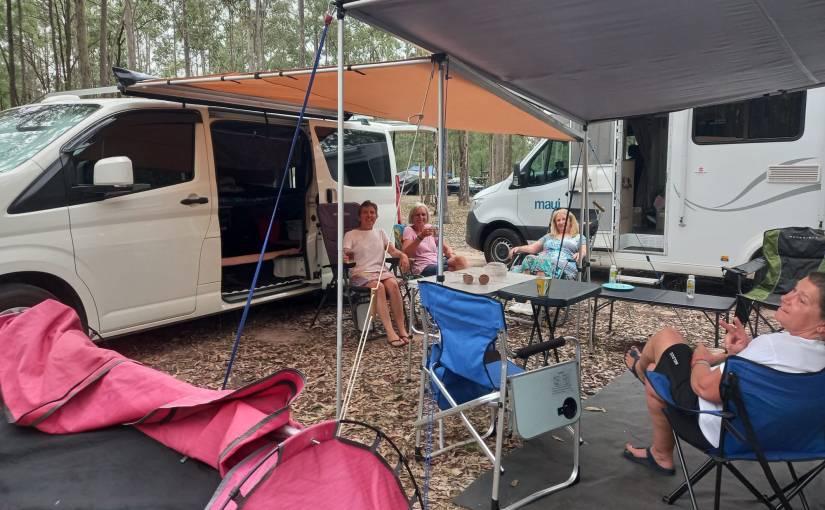
I have a little story here that I recently wrote and had published in the Society of Women Writers’ magazine, Women’s Ink, for their 100th year anniversary. It’s a story about a recent adventure I had with a bunch of women friends. They pushed me outside my comfort zone and taught me that the campervan life was a lot of good fun. So, here’s the story and I hope you enjoy it.

Finding Fun

Listening to the rain as I lie in the dark, I ask myself if this is fun. I’m dry. I’m warm. Actually, I’m quite cosy. But the noise of water on metal is loud and the boxy motorhome is shuddering. A clunk reminds me that I’m camped in a forest of gum trees, tall and spindly things, young and limber. Not widow-makers, fortunately. I wonder how my gutsy friend is coping in the swag. Is she still dry? Is she safe? Should I get up and go out, bring her inside to sleep on my floor? Would she already have crept inside one of the other girls’ vans since we’re all parked together in a commune-like square? We’re in this together, I remember one declaring before we left the last camp, a spontaneous and abrupt decision as another read the weather report. Shithouse weather approaching, the BOM said. We should go, Wonder Woman said. Waiting til tomorrow would mean setting up in the storm and possibly getting bogged. They all agreed. But, but… I said, panicking because that wasn’t the plan and my mind isn’t pliable. I’d been thinking a cup of tea would be nice, and then perhaps a stroll on Jimmy’s beach… Later, I was told with much hilarity that I looked like a stunned mullet.

The corners of my mouth turn up. I stare at the shadow of carpet-lined ceiling and recall my friends leaping into action, jollying me along as the newest member of the group. As the novice – the princess in the rented, oversized, Maui – I got a lot of encouragement. Once they had packed up their compact, perfectly fitted-out campers they assisted me with mine, cooing over the toilet and shower, the electronic bed, the three-burner cooktop, and laughing as they guided me to empty the toilet cassette and unhook the grey-water hosepipe. They were supportive and enthusiastic, and determined that we would be well set up for the Xavier Rudd concert in the Hunter Valley the next night.

I climb down the ladder from my elevated nest. I lift the blind and peer out, see nothing but phantom shapes. The white vans glow grey, their awnings slicing the dark. The swag looks ominous – a long, black, indiscernible body. Apart from the shivering trees and the falling of exhausted leaves, there is no other movement. I can’t see the rain. I can’t see my friends. I can’t see any reason to go out into the eerie and wet world. I use the luxurious toilet, then climb back up to bed.

Curling up on my side I think of my gum boots, the mud, and the other competent campers who decided to setup on the grounds early. The rain started on nightfall, just as predicted. My gang are a clever bunch. I feel smug that I’m with them. They taught me to play a card game yesterday, the first in my life. It challenged me and made me happy. I pull up the doona, snuggle in and smile. Yes, this is fun.
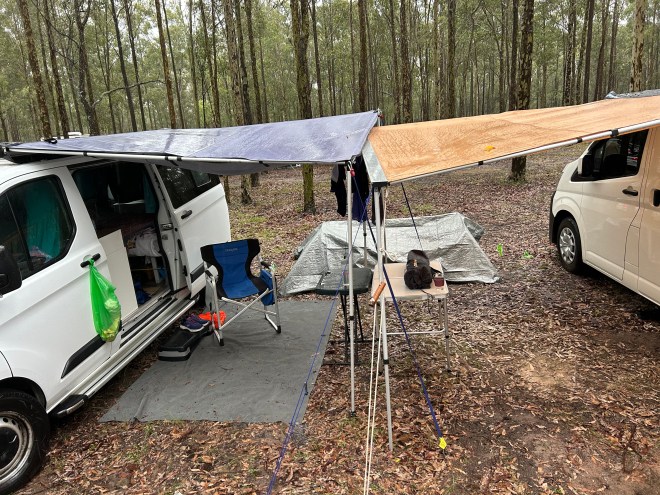
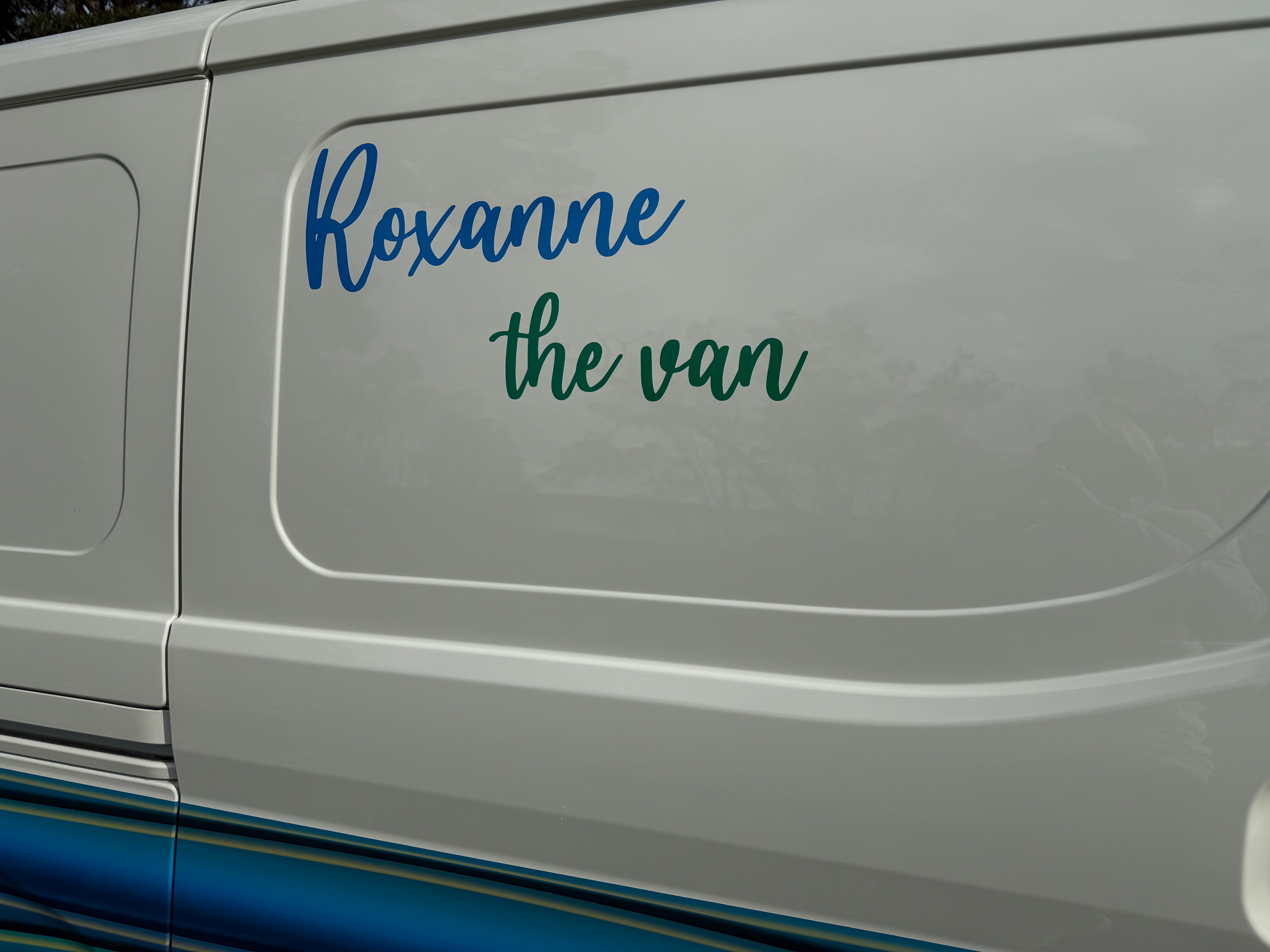
I had so much fun on this trip, I ended up getting my own campervan, a Toyota HiAce I had fitted out myself and called Roxanne. I’m looking forward to more adventures with my friends, fun times I’ll be sure to write about.

How have you found new ways to have fun in the various stages of your life?
Letting Go and Liberation

The Decision to Discontinue the Pursuit of a Publisher

In my last blog, I expressed the quandary I was in about my novel; cut it to fit the requirements of current traditional publishers of contemporary women’s fiction or do it my way and alone. I concluded that I would do a tighter rewrite but wouldn’t alter my story. Therefore, I would self-publish if necessary.

Since I decided that, I have felt a rush of enthusiasm for my work. I feel invigorated, inspired, motivated, and most of all, liberated. All that, despite previously feeling like I’d had enough.

I believe the key to this change of heart was the decision to let go.

Originally, I had no interest in publishing my story. I just wanted to write it, improve on it, improve on it again, and print it for family and friends. The achievement was enough.

Somewhere over the eight years, though, mixing with other writers and published authors, I fell into the trap of wanting more. I wanted SUCCESS. As my manuscript got better, I hoped a well-respected publisher would tell me my work was good enough to put money on, that I was a good writer, that all my effort was worth it because my book would be loved.

To achieve this, I was willing to make adjustments until I reached the goal. Perfectionist traits spiked and fear of failure set in. My own value got more and more entangled in the process. The desire to succeed became a need.

It wasn’t until my last manuscript assessment that I realised what I was doing. I wasn’t just striving to make my book better; I was striving for recognition and approval.

As I went through the editor’s report, I decided what advice I agreed would improve the work and what was non-negotiable in my story. I saw how subjective it all was and how important it was to me to write how I liked. Suddenly, traditional publishing came second to what I thought was good. And my writing, I realised, had become good.

This self-recognition has allowed me to let go of the need for a traditional publisher’s affirmation. My harsh inner critic has taken a back seat too. I feel like I’ve been set free of shackles and I’m running my own race.

As per the professional advice I was given, I have rewritten the beginning of my novel. I decided to treat it as an experiment, something that was worth investigating but not so important I couldn’t throw it out. I was surprised by how well it turned out. I’m so happy with it, in fact, that I decided to send it to the agent who currently has my submission (has had it for almost three months). I’m not sure whether it was a good idea. But who knows? I won’t let the outcome constrain my work.

After all, it’s my new-found freedom that’s allowing my writing to flow.

The Publication Dilemma

Eight years ago, I started drafting a novel. The story came to me as I was settling in to my new life as a single woman. I journalled and talked to other women who were going through similar things – women in mid-life who were experiencing changes in their circumstances, bodies, hearts and minds. Complete with its three female characters, the story encapsulated many of those changes and how the women were transformed through dealing with them. The story may have been created in my mind, but it was as if it came to me on the wind, landing in my lap like a feather.

The message was clear: Ladies, you’re not alone and if you’re brave enough to be open and honest, to let go of certainty and take a chance, and to prioritise yourself (for a change), you’ll grow and you’ll fly.

The reason I’m sharing this is because the story is in danger of being grounded. The process of shaping it for publication is starting to feel like clipping its wings. I don’t quite know what to do next, but I know from experience that being open and honest helps.

For eight years I’ve gone over and over this story, drafting, editing, and re-writing it after each manuscript assessment, improving it but also shaping it to fit the genre of contemporary commercial women’s fiction. This genre is character and theme driven and according to professionals, this is where my novel sits. I get it. I agree. But, in some ways, it’s not fitting the mould.

For a start, a story with three protagonists (three character-arcs and three plots) has caused there to be a lot more words than today’s publishers want. It’s too big for the genre, especially for a debut novelist like me.

Another irregularity is that one of my characters leaves the other two and as a result has a partly separate story. Normally, in this genre, the main characters are intrinsically linked so that their actions impact on one another.

Mostly the story is set in Australia but this character returns to her birthplace, India, for a period of mourning. This leads to another editor’s issue: is it appropriate for me as a white woman to be writing from an Indian woman’s point of view? And why India? My answer is I’m fascinated by India, love the place and its people, and know women there who want their transformation story told too. And India has always been a part of this story, the one that chose me to land on.

So, what do I do? I have always said that I want to be traditionally published. I want the recognition, the kudos, the built-in marketing. But to be accepted I would need to make my novel fit the mould. And that’s not sitting well with me.

Is that because I’m a restless middle-aged woman who wants to do it her way and hopes to fly? Or because I’m a little woo woo and believe the story should remain as it arrived? Or because writing should be unconstrained art? Or simply because I’m running out of energy? I’m not sure, but I think I’m coming to the conclusion that traditional publishing isn’t worth the effort.

I’ll add one more reveal. My confidence rises when I’m happy with my writing, when I feel I’ve been genuine. It falls when I get back an editor’s report and try to make the writing fit a format. So, what is that telling me?

I want my novel to soar. I want people to relate, to get it, to be inspired by it. I’m willing to follow guidelines on good story-telling to give it the best chance. So I’ll give it one more makeover, pluck out a few extraneous scenes. But I must stay true to the story. I must write it how it wants to be written and include all I have to say.

It seems clear now that I need to be free of constraints, and when I write THE END this time, I need to be brave enough to publish it myself. Who knows what will come of it? But at least I’ll be setting it free.

Mindset Hack


Thinking that you GET to do things instead of thinking you HAVE to do them, is a well-being hack I picked up from scrolling through social media this week.

Having a few minutes spare, I opened Instagram to vicariously enjoy friends’ holidays. I paused as a Reese Witherspoon video appeared and being a fan of this brilliant woman, I chose to stop and listen to what she had to say. Yes, it would take the few spare minutes I had, but that’s what happens on social media, so stay with me.

She has credited Steve Guttenberg for this insight, but I’m sure neither he nor Reese are the first people to pronounce it. The advice is: instead of saying you have to do such and such, say, I get to do such and such.

It changes the mindset – the attitude you have to the task or the situation.

I get to rise at dawn so I can write more of my novel. I get to exercise each day so I can stay healthy. I get to work, go shopping, do the washing, clean my house, make a phone call, go to the physio, walk the dog… You get the picture. I’m fortunate I get to do these things.

Changing the words you use changes the way you feel. Instead of feeling weighed down by a have to, feel uplifted by a get to.

The get to generates gratefulness and positivity.

I get to write my blog once a month. I love doing it because I get to express things that interest me. But I often reach the time it should be published – like today – and feel pressured because I also have a novel to write and a life to live. We all feel pressured by the things we need to do, right?

So, when I woke this morning thinking, I have to write my blog, Reese’s video came back to me. I changed that thought to I get to write my blog, and I instantly felt a little burst of positivity. It was just enough to make me see I also have a choice as to how much time to spend on it. And here is the result. I hope that you benefit from it.  

Why Write a Blog

Does anyone read my blog? Why do I write it?

These are questions I have been asked, from time to time, by close family and friends. Sometimes, I have asked them myself.

I don’t know how many people read it. I don’t look into the stats, and I don’t ask people I know. I do get a thrill when someone comments. Even a Like is enough to give me a ripple of satisfaction.

But I don’t write it for others. Not predominantly, anyway. I figure if my words are interesting and true, they will resonate with people. Perhaps someone will learn something. Perhaps I’ll change someone’s mind or expand it. That’s not my business. Expressing myself, is.

Self-expression is the main reason I write. I find it easier to write what I think than to say what I think. Writing gives me the chance to process a topic I’m interested in. I can research and whittle information down to concise points. I can think as I’m writing and then I can refine the words until I have a good understanding of a topic.

The reasons I specifically write a blog, though, are more diverse.

When I started writing a novel, I was advised by those in the know that a social media presence was necessary. That was a long time ago, back when I had no idea a novel was going to take me over seven years. I opened a Facebook page and started a blog. Regular input was advised, so I tried to write monthly. Sometimes I didn’t make it and there were blog droughts. But this year I am thoroughly committed because I can see the publisher’s light at the end of the tunnel. Blog Posts have renewed importance.

Another reason for writing a blog is that it gives me an excuse to follow varied and unrelated interests. I am interested in the natural environment, the topical issues in my community and my country, the mystical and spiritual, character traits, relationships, the craft of writing… so many things. My blog covers whatever piques my interest at the time. Sometimes it’s related to issues in my novel. India seems to be mentioned a lot.

Publishing monthly adds pressure to my life, but it also adds satisfaction. I get a buzz out of a Post’s completion. Since the novel has taken so long, these little bursts of goal setting and achievement are like snacks during fasts, roadhouses on a desert highway.

The writing is also practise. I get to refine my skill as a writer.

So, the why is clear. I write because I like to. It adds quality to my life.

As to the readers, I know I have a few. Sometimes, they have let me know that I’ve touched them. And that’s greatly satisfying. I like to think I have added quality to someone else’s life. It would be rewarding to know a Post of mine started a conversation.

If you enjoy a Post, it will help me if you hit Like, make a comment, and Share it. Two-way conversations are always better than monologues.

Maybe, after this Post, you’ll even be inspired to write your own.

Writing Well

This month’s blog is simply an expression of how I’m feeling about writing right now. Oh, the joy! It feels like my ten years of learning the craft in courses, workshops, and books, plus my six years of writing and re-writing my first novel, have all come together to form a passage through to the end of Draft Seven (a euphemism for Draft Gazillion), also referred to as the Submission Draft.

Finally, I feel like I know what I’m doing. My visualisations of signing a contract, of editing the final manuscript, of beholding a beautiful cover, of holding an actual paper book and seeing it in a bookstore, have all re-emerged. I see myself being interviewed, being introduced as an author, being congratulated on a message well-said. I’m loving it!

So, what has brought me to this point? Enthusiasm for writing, the wonderful people who write, a story that won’t go away, dedication, determination, and resilience. And a year that has so far brought three gifts:

  1. A workshop by Dani Abernathy on The Art of Emotionally Impactful Storytelling (found through the Fiction Writing Made Easy with Savannah Gilbo podcast),
  2. the discovery of Save the Cat! Writes a Novel by Jessica Brody, of which I used the summarised beat sheet, and
  3. Jennifer Marshall, a writing buddy turned book coach who has helped me plot a structure that will keep me on track for a strong character and story arc. Since engaging her services, my writing has taken off and so has my confidence.

Every author I’ve ever listened to has strongly advised having at least one writing buddy. Someone to bounce ideas off, check work with, be motivated by. Jen has understood my novel so intuitively, that it’s like she sees the gold vein in the rock walls. She’s able to extract the message of my story, and the good stuff from my sometimes-dense brain. With her reflecting what I say, problems are getting solved.

In all, I’m on track for submitting my novel to agents and publishers this year, hopefully in the first half. Writing my pitch, synopsis, and cover letter for submission might be my biggest challenge. But now I know I can do it. Light is shining from the end of the tunnel.

Here’s my practise pitch:

The Rest of Their Lives is a heart-warming, contemporary story about three friends facing the challenges common to women in middle-life. It’s about love and loss, hard choices, and self-discovery. Set in Australia, India, and Ireland over the course of a year, these three brave women re-write the next chapters of their lives.

And now, it’s back to work – the joy of writing well.

If any of my writing friends are reading this and thinking they could do with a hand, contact Jen through me. I can’t recommend her enough.

India and My Soul

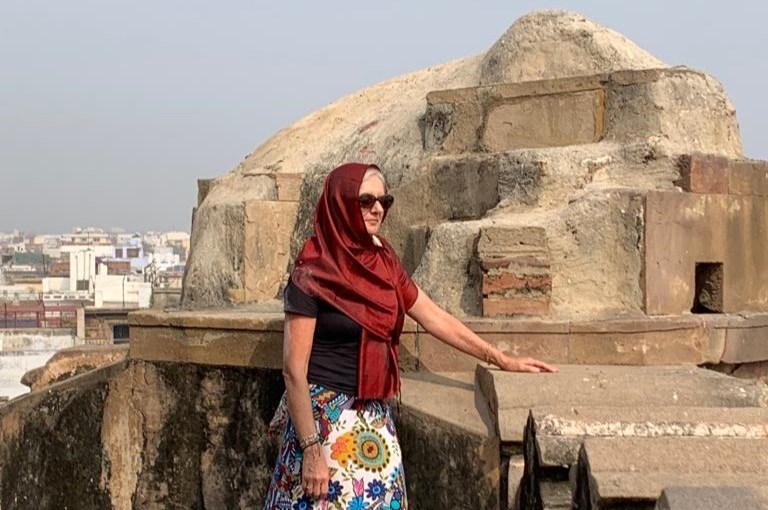
In November, I visited India for the fourth time. I’m drawn to the place like a magnet, like my energy is attracted to its, like my soul gets caught on the prevailing wind.

It is a land of fascinating human history, evidence of which can be seen in forts and palaces and temples. Its people are friendly and musical and resourceful. Of course, it has its problems, and like everywhere else in the world, they’re man-made, but sweeping the trash aside, India is a beautiful and exciting place.

Each time I’ve been, I’ve had a mission: the first was to visit the big sights of Rajasthan and South India; the second to do research for my novel-writing; the third to spend nine days in an ashram at a women’s festival focused on saving the planet (with my guru, Liz Gilbert); and this fourth time was twofold – to check out a residential school for disabled kids run by an incredible woman I met at the ashram, and the other, to join a group of writers in a tour aptly called Story Hunters.

The school turned out to be a treat, a happy place where kids were thriving. Kids who had suffered birth trauma, disease, or lack of pregnancy care, who would normally have no opportunity for happiness, were being educated, looking after themselves and each other in a positive environment, playing sport, laughing. I got to hang out with the girls in their common room, having my hands painted with henna, dancing.

The group of writers turned out to be an eclectic bunch of highly creative and deep-thinking women.

Story Hunters was the vision of a man who wanted to connect a bunch of curious, foreign writers with types of Indians who don’t often get to tell their stories.

Travelling with us was a young Indian woman with impressive qualifications who acted as facilitator, herder, and interpreter; a musician who played violin, guitar and wooden flute, who sang and wrote poetry; and an earnest, young videographer and documentary maker with the sweetest of hearts.

We got to meet with:

  • gypsies who live on the edge of the Thar desert, who perform dances, play instruments, and do tricks like pick up razor blades in their eyelids. Their pride and their personal stories of loss have affected me forever.
  • street-sweepers – a mother and daughter-in-law – who were accompanied by a male family member in order to be decorous.
  • a jeweller who broke away from his family’s traditional silver-smithing style to make highly imaginative artworks from metals and gems and fossils. He almost died from Covid, then a great light lifted from his chest, leaving him completely well.
  • a Naga sadhu in Benares (Varanasi) who was once a successful software developer who now devotes his life to attaining enlightenment.
  • a Sufi priest who explained that Sufism is about finding truth, liberation, reality, and love. He spoke eloquently, sang Kabir’s poetry, and played tambourine with dancing hands.
  • a tuk tuk driver in Delhi who turned his life around with the love and support of his wife – a love marriage between a Muslim and a Hindu that survived his drug addiction and imprisonment – becoming an honest business owner, able to put his sons through private school.
  • Hijras – people of the ‘third gender’ – whose personal stories of hardship, ostracism and desire for love broke my heart.

We spent days in India’s last living fort, Jaisalmer, and more by the great, holy Ganges in Varanasi. We visited ancient sites including a 350-year-old Mosque built with the remains of a Hindu temple and the remains of a city, reportedly abandoned 800 years ago. We learned about caste, religion, gurus, Hindu gods, and Diwali. We explored alleyways and danced on the river’s ghats, singing Hindi and Beatles songs with our very own troubadour.

My fourth trip to India turned out to be exceptional. I learned so much that it took weeks to process once I was home in the quiet, open space of Australia.

On reflection, I wonder if the gods play their part in returning me there, time and time again.

Vayu, the guardian of the northwest direction and the Lord of the Winds, may be my universal facilitator. No doubt, I will do this exhilarating journey again and like the much enjoyed roller-coaster of my childhood, I will find myself weeping with pain and blissful with joy. India burns in my heart and like the flame of the diya (the sacred oil lamp), it will remain the light of my soul.

REFERENCE

School for children with a physical disability – SKSN: https://sksn.org/

Story Hunters: https://www.blueswan.events/

Writer’s Journey – https://www.writersjourney.com.au/

Between Draft Blues

In the last six weeks I have written nothing to do with my novel. I’m in Pause mode, in the space between drafts. It feels like limbo, like I’m adrift at sea in a dinghy, unsure that I’ll ever make it back to the main boat to which I’m usually tethered. I’ve been patiently waiting on an author-connection to assess, edit and hand back my manuscript.

An established author who is willing to wade through the muck that is a first-time writer’s work, who is willing to pay attention and use her authorly skills to give advice that will better that work, is, in my view, a fairy godmother. My expectation was that copious amounts of magical instruction would be sprinkled over me like fairy dust, acting like a salve that had the power to transform and transfigure my rather voluminous housedress of a fifth draft into a silken, fitted ballgown. With sparkly glass slippers.

Unfortunately, the wonderful author is human, and this is real life and stuff happened that has prevented her from wading through that muck.

And so, I’m drifting. Directionless. How will I fill in time while I wait for another generous, willing author, to make her way through my storyland, planting seeds and slashing weeds along the way?

The first thing I need to do is relax. Many authors advise to take time off between drafts. At least a month, say some. I’ll come back to it refreshed and see it through a new lens, right? But what if I forget what I was trying to say? What if my characters forget to inform me?

I need to distract myself and focus on all the things I think of doing while I’m trying to write. There are a million things I could do varying from reading to exercising, short courses to socialising, redecorating to cleaning grout. Procrastination comes so easily when the manuscript needs work, so why not now? After utilising the initial month’s break for a two week adventure-holiday, catching up with long lost friends, and listening to writerly podcasts – all very satisfying – I’ve found the extra time has not been so productive.

Perhaps then, I need to revert to a schedule. Get up early, do something writing-related for an hour and a half, like I’m used to (I’ve just enrolled in two online writing courses!), read, exercise, listen to podcasts, research something of interest… Am I mad? What human that lives by a schedule doesn’t crave a holiday from a schedule?

I guess the problem is, I just want to get back to writing my book. I miss it, miss my characters, and miss the progress now that completion is finally in sight. It’s been a long journey. I’m in my sixth year of writing. It’s been hard with lots of heartache and angst and deprivation. But it’s looking like a half decent story worthy of the three women characters who are so brave and loving and formidable.

Waiting has always been hard. Patience needs to be practised.

I know I won’t forget the book’s message and my characters are way too keen to have their journey to let me forget anything they need to do. So, I’ll take a deep breath, step back, and let my sub-conscious and the Universe do what they do best: test me, teach me and make magic.

At least I’ve got time to get back to writing my blog.

An Emerging Writer’s Spiel

When it comes up in conversation that I’m writing a novel, I’m usually asked what my book is about. I’ve always struggled with the answer to this, not because I don’t know what I’m writing but because I never know whether to tell the story or whether to reveal what it’s really about, it’s message.

If I was asked by a prospective publisher, I’d want to give my twenty second pitch. But even that befuddles me. There’s the advice that as an emerging (unpublished) author, a hook – something vibrant and catchy – is required. But that’s so subjective I can’t formulate one.

My genre is fairly clear, at least. It’s contemporary – probably women’s – fiction. But if a publisher put literary in that description, I’d be thrilled. Literary fiction is what I like to read. It’s what I admire.

So I’ve created an answer that merges story with message and I hope it sounds intriguing.

It’s about three friends who are dealing with the challenges common to women in middle life. It’s about their experience of love and loss, family and friendship, and the choices they make to rewrite future chapters of their lives. It’s set in Australia, India, and Ireland over the course of a year.

This draft will be finished by June – I’m going for positivity – and then I’ll have another look at that pitch and send off my manuscript to the highly selective world of agents and publishers. I’ll finally walk the talk and show all my commitment and perseverance.

If anyone has any advice for me, please post it here. Likewise, if you like my spiel, encourage me with a thumbs up.

Happy reading, dreaming, and writing, my word-loving friends.

Pushing Through: Writing Past Insanity

I don’t often write about writing but since I’ve been finding it challenging lately, I thought I could share with you why sometimes I think persevering with the writing of my novel is insanity, and why I persevere, anyway.

Firstly, for context, this is my fourth year of writing. I call the draft I’m working on Draft Four because I’ve started again four times. The beginning and end have never changed. The themes and characters haven’t either. The changes happen in the guts of the story and the quality of the writing.

The moments when I question my sanity come when I’m struggling with a scene; it’s the difficulty in creating a story that is right for the character, right now.

The thing is, there has to be a point to the scene. It has to have enough nutritional value for the character to grow or change in some way. There has to be a reason for the chicken to cross the road, and it’s not just to get to the other side. It’s what is going on in the chicken’s head or heart that the reader needs to understand.

And then, the series of scenes need to progress in such a way that the reader wants to go further with the chicken because they can sense that the chicken has great potential and will one day be the mother of all chickens.

The problem comes when the difficulty causes so much struggle that it provokes the fight, flight or freeze response. I glue myself to the desk and write anything because I won’t let it beat me and Liz Gilbert has drummed into my head that perseverance is the way. Or I find an urgent task to do, like rearrange the shoe cupboard, or go to Bunnings for, well, anything. Or I lie on the floor because suddenly, my body is so tired, and I think, how did I come to be doing this?

But then I remember why I’m doing it. It’s because I have a message and my characters are living and standing on the side lines, never leaving me, wanting me to write them in so they can convey it.

And also, because I’ve come so far. Let me explain.

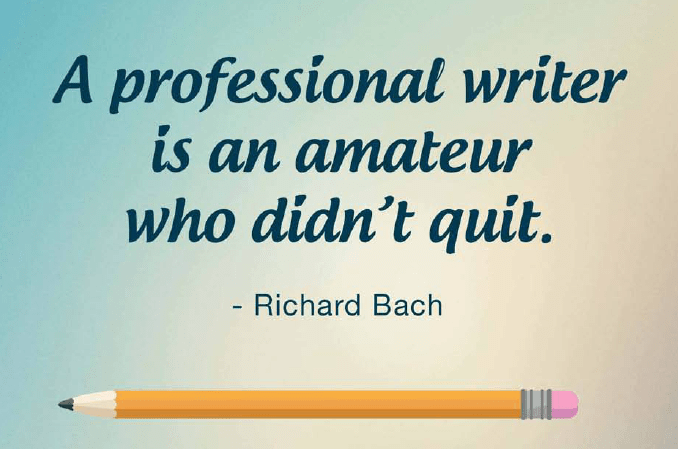
I have spent so long on it that I couldn’t bear to have wasted my time. And I wouldn’t like to be judged a bailer, or worse, a failure. Especially by myself.

I have become a better writer. At first, I was a beginner. Learning a new skill takes time and practise, and with every draft, I’ve given my writing plenty of both. The expression and style have improved as my skill grows. Which reassures me even now, as I struggle, because I know I’m still learning, and I will still improve.

Rewardingly, as a person I have grown. Becoming skilful in something creates confidence. Persevering at something that’s difficult improves resilience. Writing a believable story requires understanding of human nature and the world we live in. I am becoming wise. I am transforming along with my characters. We’re in this together. I can hear them cheering.

Finally, the moments of struggle pass and the words flow. I feel sane and deliriously happy at the same time. Perseverance pays. I will do whatever it takes to cross the line. And whenever I can, I will stop to admire the scene. Eventually, this novel will be done.

PS: To any struggling writers (or creatives) out there – You’re not alone and it’s worth pushing through. Imagine the struggle to be fog. When the fog passes, it will be a brilliant day.