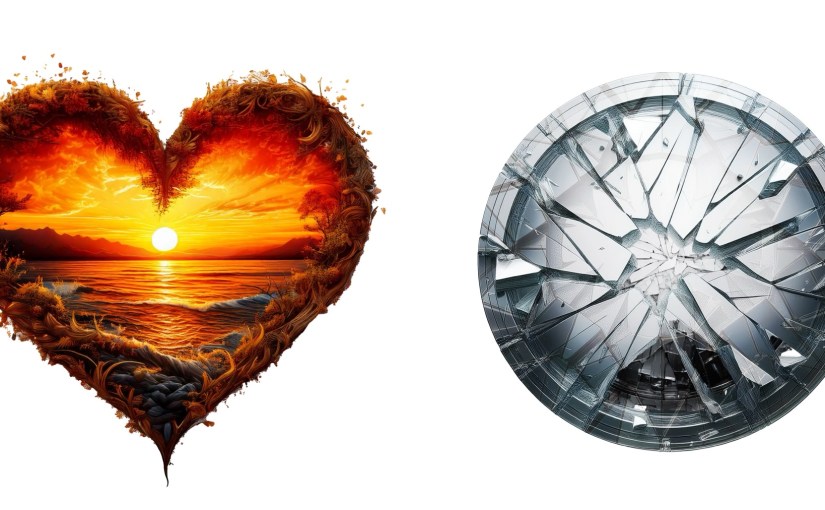
What is ego? I’ve asked myself this question since 70’s band Skyhooks sang, “Ego is not a dirty word.” It seems it doesn’t have an easy explanation or a clear definition unless we accept the dictionary version which only touches the surface: a person’s sense of self-esteem or self-importance.
I’ve studied many spiritual, self-help and awareness books. I’ve listened to gurus and spoken philosophically with other learning friends. I’ve spent hours thinking, practising breathwork and being present in an attempt to be a more conscious, authentic, and connected person. During this process, I’ve tried even harder to understand what ego is, and why it might, after all, be a dirty word.
In his book, A New Earth, Eckhart Tolle thoroughly explains ego. I highly recommend reading or listening to anything this enlightened man says, but I’m going to do my best to summarise his words.
Ego is identification with form, primarily thought forms, but also physical and emotional forms.
What does that mean?
It means thinking we are our thoughts, our minds, our bodies, and our abilities. It means endowing with a sense of self, stuff we own, people we mix with, where we live. It means identifying with a type, a style, or behaviour.
Any conceptual sense of self – seeing ourselves as this or that – is ego, whether predominately positive (I am great) or negative (I am no good).
Behind every positive self-concept is the hidden fear of not being good enough. Behind every negative self-concept is the hidden desire to be better than others. Whenever we feel superior or inferior to anyone, we are being led by our egos.
The egoic mind is completely conditioned by the past. The content it identifies with is conditioned by upbringing, the environment, and our surrounding culture.
The ego lives through comparison. How we are seen by others turns into how we see ourselves, like a mirror that tells us what we are like and who we are. The ego’s sense of self-worth is in most cases bound up with the worth we have in the eyes of others.
The ego tends to equate having with being – I have, therefore I am. And the more I have, the more I am. This ego-identification with things creates our consumer society and economic structures. But things are identity enhancers and don’t last.
When forms we identify with are no longer there, the ego can collapse but quickly reemerge with a strong mental image as victim. Negativity, resentfulness, and bitterness form and as we criticise and complain, the ego gets stronger causing a feeling of superiority, which in turn creates more negativity. Our perception becomes selective and distorted causing us to see what we want to see and then misinterpret it. Life will not be helpful.
When we shift our focus from the external to the feeling of aliveness within us, we sense our essence, the formless dimension, the state of consciousness called Being that is really us. Any actions we take will be in alignment with the whole and supported by creative intelligence. There will be inner peace.
There is a deep interrelatedness between our state of consciousness and our external reality.
Realising that what we perceive, experience, think or feel, is not who we are, and understanding that the desire to stand out, be special, be in control, or have power comes from fear – the fear of being nobody, the fear of non-existence – leads us to the connection with our true, formless selves, our essence identities, and to all living things.
When we accept that it is ego – identification with culture and country and religion and roles – that separates humans and causes conflict and unhappiness, when we become aware that it is ego that limits us and prevents us from being compassionate, when we learn non reactivity and are peaceful with the present moment, we find ourselves attuned to a far greater intelligence than the cleverness of our egos.
All that is necessary to become free of the ego, is to become aware of it. Awareness is the power that is concealed within the present moment. It is called Presence. Only Presence can undo the past in us, thereby transforming our states of consciousness.
I finally understand that ego is an illusory sense of self, that it is limiting and harmful and masks a far greater dimension that is our true essence, the spirit within. Becoming aware of thoughts and emotions as they happen, accepting reality, and disidentifying with all types of forms which create negativity, allows that essence to shine and creative intelligence to win.
I, for one, now I understand ego a little better, will do my best to go beyond it and be my best and truest, most present self. I won’t pretend it will be easy, but awareness and practise will help. How about you? What’s your ego doing right now?
If you’re interested in furthering your understanding of the concept of ego and consciousness, I’d recommend:
- Anything Eckhart Tolle says https://www.youtube.com/watch?v=VauHIuyPwkM https://www.youtube.com/watch?v=bYH7rR4EKTU
- Anything Sadhguru says https://www.youtube.com/watch?v=85GQKr_gFPQ
- Any books by Osho Osho Quotes on Ego
- Steering by Starlight by Martha Beck
- Aboriginal Secrets of Awakening by Robbie Holz and Gary Holz
- The Seat of the Soul by Gary Zukav
- Conversations with God by Neale Donald Walsch
Artwork created by Carla Simmons, Ric Holland and AI art tools.
 Carla Simmons Writer