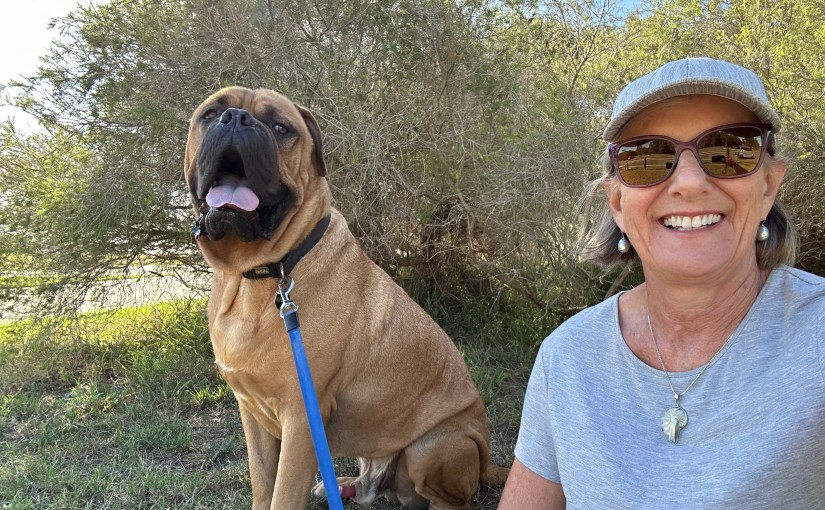
Letter from a Big Dog

Dear Dad,

Thanks for leaving me with Grandma, but you’ve been gone a long time. Where are you? When are you coming back? I wonder if I should escape and try to make it home. Sigh! I don’t think I could. I can’t exactly fit under the gate.

I don’t mind staying with Grandma, but some things could be better. I wish you’d tell her it would be nice if she let me sleep upstairs with her. Keeping me downstairs is bewildering. I could keep her company on the long, lonely nights if she let me sleep next to her bed. She wouldn’t even need to keep her eyes open since she could smell my eau de Dogue and hear my melodious snore. She doesn’t know what she’s missing, so would you please tell her to let down her guard – literally, the one that barricades the landing – and chill. I’ll do the rest. For your information, I did try to let her know that’s what I wanted; it might have been too subtle. I fitted myself, with some effort, along one of the steps, and attempted to sleep there. Fortunately, she snuck a look from top of the stairs to see if I was settled, noticed my awkward position and came down to put me back on my bed, but she didn’t invite me to go up with her. She’s a harder nut to crack than I thought. Still, I was grateful she got me off the step. Scrunched up as I was, I would’ve had a crook back by morning if I’d stayed there. You know, most of the time I don’t notice I’m such a big dog. I really feel quite small inside, which is why I get surprised when humans get flustered as I gallop to greet their furry companions or when I find myself blocking a passageway. Anyhoo…

Talking about my statuesque figure brings me to another point. Do you think you could persuade Grandma to buy a bigger car? One with a proper, big boot like ours? It’s nice for her that I can be so close when she’s driving, and I know she likes to have me breathing down her neck and looking over her shoulder, but being on the back seats isn’t my ideal. I can only lie along them; not move my rear around however I want. There is the advantage of the open window – when she thinks to put it down – and I do like poking my muzzle out and letting my floppy jowls flap in the breeze. But still, it’s undignified and when we’re stopped at the lights, dogs in other cars look at me funny. Really, if she continues to want to take me on long trips, she does need an appropriately dog-sized vehicle.

Speaking of stopping, like, outside of cars, does she ever? I follow her around the house trying to be a good companion, but when she finally sits and I’m all settled and starting to snore, she’ll jump up again and go someplace else. I force myself to snap out of my slumber to keep an eye on her, and sometimes I go to the trouble of pushing myself up off the floor to check on her, but then she’ll turn around and go back to where she started. I can’t understand it and I wonder why I bother. She can even repeat the same thing again five minutes later. It’s exhausting, I tell you. And she looks at me as though I’m simple.

Anyhow, I forgot to tell you about the scary storm the other night. I’m not exaggerating, it was like the sky dogs were in a battle and each time they growled and lunged at one another, lashings of spittle would spear the earth in gusty blasts and their gnashing teeth made blinding explosions. It was terrifying. And to prove that Grandma is a bit odd, I’ll tell you what she did when the noise and flashing and spit eased off a bit before bed. She opened the door and went outside! Then she called me! I had to pee, so I went but I didn’t dilly dally. I ran straight back inside. Next thing, Grandma’s strolling up the street picking up all the bins that had fallen over, even though she was getting wet, and the sky was still stroboscopic. The storm must have fried her brain! Seriously, I was close to crapping myself. And even with all that, she still left me downstairs. Don’t you think that’s mean? Even if I did get double treats.

The next day, on the drive to the river house, we stopped twice for Grandma to stretch her legs. She made me get out of the car both times and walk, which wasn’t too bad, really, especially because I persuaded her to give me treats to get back in. We had another walk before bed, but I think I must have been too distracted by the luscious aromas of roo poo and forgot to poo myself, because during the night, as I remembered the scary storm, I finally did crap myself. I didn’t mean to, of course, but it was a good-sized dump and had to come out. Grandma was asleep with the door closed so I chose a spot I didn’t think she’d find for a while, but surprisingly, she found it as soon as she got up. She must have felt guilty about the previous night because she just gave me breakfast without comment and when I came back inside, the crap was gone. She had already forgotten about it. Which is good, but you know, she is a bit vague sometimes. Anyway, Dad, sorry about the dump. But if Grandma hadn’t kept me out of her bedroom, I could have warned her it was coming.

Which brings me to where I’m sleeping. She put my bed in the lounge room, which in my opinion is too far away for comfort. I did the sad eyes, and she then moved it to the corridor, but then I decided I wanted to sleep in the guest room. I am a guest, after all, aren’t I? She didn’t kick me out – a moment of sanity – but she did move my bed back to the lounge room. Honestly, I don’t get why she just doesn’t let me sleep next to her.  It’s frustrating that she deprives herself like that, at her age.

So, the only thing left to tell you is how fit I’m getting. Grandma walks me three times a day: a small walk, a big walk and a wee walk. I go swimming and play with friends, Jack, Ronnie and Susie. They can be a bit temperamental, especially when I’m feeling bouncy, but they’re okay. They don’t scare me with their snarly faces and usually, we just get on with it and walk or fetch sticks. When Grandma lets me off the lead, I like to chase birds, especially ducks. Grandma calls my name, loudly, and I know she’s cheering me on, so I run faster. Sometimes she pulls snarly faces too.

Finally, I think you should let Grandma know I don’t speak her language. Sometimes she talks to me, and I have no idea what she’s saying. I just give her my best blank expression, so she gets the hint, but then she laughs. She is a bit simple. Sweet, though.

So that’s it from me. I hope you feel better now you know how I am. Hurry up home.

Big Chief. xx

What is Ego?

What is ego? I’ve asked myself this question since 70’s band Skyhooks sang, “Ego is not a dirty word.” It seems it doesn’t have an easy explanation or a clear definition unless we accept the dictionary version which only touches the surface: a person’s sense of self-esteem or self-importance.

I’ve studied many spiritual, self-help and awareness books. I’ve listened to gurus and spoken philosophically with other learning friends. I’ve spent hours thinking, practising breathwork and being present in an attempt to be a more conscious, authentic, and connected person. During this process, I’ve tried even harder to understand what ego is, and why it might, after all, be a dirty word.

In his book, A New Earth, Eckhart Tolle thoroughly explains ego. I highly recommend reading or listening to anything this enlightened man says, but I’m going to do my best to summarise his words.

Ego is identification with form, primarily thought forms, but also physical and emotional forms.

What does that mean?

It means thinking we are our thoughts, our minds, our bodies, and our abilities. It means endowing with a sense of self, stuff we own, people we mix with, where we live. It means identifying with a type, a style, or behaviour.

Any conceptual sense of self – seeing ourselves as this or that – is ego, whether predominately positive (I am great) or negative (I am no good).

Behind every positive self-concept is the hidden fear of not being good enough. Behind every negative self-concept is the hidden desire to be better than others. Whenever we feel superior or inferior to anyone, we are being led by our egos.

The egoic mind is completely conditioned by the past. The content it identifies with is conditioned by upbringing, the environment, and our surrounding culture.

The ego lives through comparison. How we are seen by others turns into how we see ourselves, like a mirror that tells us what we are like and who we are. The ego’s sense of self-worth is in most cases bound up with the worth we have in the eyes of others.

The ego tends to equate having with being – I have, therefore I am. And the more I have, the more I am. This ego-identification with things creates our consumer society and economic structures. But things are identity enhancers and don’t last.

When forms we identify with are no longer there, the ego can collapse but quickly reemerge with a strong mental image as victim. Negativity, resentfulness, and bitterness form and as we criticise and complain, the ego gets stronger causing a feeling of superiority, which in turn creates more negativity. Our perception becomes selective and distorted causing us to see what we want to see and then misinterpret it. Life will not be helpful.

When we shift our focus from the external to the feeling of aliveness within us, we sense our essence, the formless dimension, the state of consciousness called Being that is really us. Any actions we take will be in alignment with the whole and supported by creative intelligence. There will be inner peace.

There is a deep interrelatedness between our state of consciousness and our external reality.

Realising that what we perceive, experience, think or feel, is not who we are, and understanding that the desire to stand out, be special, be in control, or have power comes from fear – the fear of being nobody, the fear of non-existence – leads us to the connection with our true, formless selves, our essence identities, and to all living things.

When we accept that it is ego – identification with culture and country and religion and roles – that separates humans and causes conflict and unhappiness, when we become aware that it is ego that limits us and prevents us from being compassionate, when we learn non reactivity and are peaceful with the present moment, we find ourselves attuned to a far greater intelligence than the cleverness of our egos.

All that is necessary to become free of the ego, is to become aware of it. Awareness is the power that is concealed within the present moment. It is called Presence. Only Presence can undo the past in us, thereby transforming our states of consciousness.

I finally understand that ego is an illusory sense of self, that it is limiting and harmful and masks a far greater dimension that is our true essence, the spirit within. Becoming aware of thoughts and emotions as they happen, accepting reality, and disidentifying with all types of forms which create negativity, allows that essence to shine and creative intelligence to win.

I, for one, now I understand ego a little better, will do my best to go beyond it and be my best and truest, most present self. I won’t pretend it will be easy, but awareness and practise will help. How about you? What’s your ego doing right now?

If you’re interested in furthering your understanding of the concept of ego and consciousness, I’d recommend:

Artwork created by Carla Simmons, Ric Holland and AI art tools.

A Plea from the Heart: The Referendum 2023

Tomorrow we’re being asked to vote in the Referendum. What a rare privilege we Australians have, being in a democracy where we all get to have a say in any changes to the Constitution (the rules for governing our nation).

What a shame that the original occupants of this land weren’t included like that back in 1901 when it was written. How different things would have been if they had. Mass stealing of children wouldn’t have happened, for one. Back then the aboriginal people weren’t seen as people so therefore, they weren’t relevant – which may be where the problems started.

Right now we’re being given the opportunity to correct the omission of First Nations people from the Constitution. We’re being offered a generous olive branch, a positive step forward. The body of representatives that is proposed to be included in the Parliament is the proposal put forward back in 2017 in the Uluru Statement from the Heart. Eighty percent of all aboriginal people want this. They see it as a step forward, as progress, as a way to express their needs and make proposals as to how those needs might best be met.

It isn’t a threat to non-aboriginals. No one is going to take your house or your family’s farm.

The Voice to Parliament is an advisory body only. Which is why some people say it doesn’t go far enough. But the Voice to Parliament will be able to advise whichever government is in at the time, regardless of their politics. Isn’t that a grand thing? Doesn’t that feel right? And that advice will be proposed by First Nations people themselves, by the people who are talking to all the ‘grass roots’ communities and mobs over this wide land.

The Yes vote is a soft approach. People say it comes from the heart. It does. But even the head can discern that it’s a step towards getting better outcomes for the Aboriginal People. That’s if we don’t let the noise confuse us. The strong, negative language used by the No voters is designed to frighten and divide us. Don’t go there. If you feel afraid, go back to basics. What is the actual proposal? What are the actual words?

Please, if you still don’t know, do your due diligence today.

The following links are basic definitions: not Yes and not No hype.

Referendum 2023 – The Constitution (aec.gov.au)

The Australian Constitution (peo.gov.au)

Voice to Parliament – Reconciliation Australia

If you want to witness a two-sided discussion that’s fair and good, I recommend the latest ABC Q & A. Q+A Live From Adelaide – Q+A (abc.net.au)

I am voting Yes and I’m voting with my heart and my head. My decision comes from a place of love and hope, the very place that the Uluru Statement came from. If you haven’t read it or listened to it, I implore you to do so. It’s enlightening.

View The Statement – Uluru Statement from the Heart.

No means no progress.

Yes means acknowledgement, acceptance and inclusion. Yes means we’re listening. Yes means the Constitution will be complete. And I’m proud to be part of that.

The Funeral

I have just been to a funeral of a man I barely knew. Strange, you might think. But not so strange since we were neighbours.

I knew his wife better than I knew him. His wife, who is now without a husband. A woman who had been married for forty years, who didn’t expect to be a widow so early, if at all. You see, her husband was only sixty-five.

She knew the boy at school, the fifteen-year-old, I found out at the funeral. They weren’t ‘an item’ until they were twenty-five, she said. He was her ‘soul mate,’ her best friend, the father of their four children, and the Nonno to their six grandchildren. Sadly, the unborn seventh, will have missed meeting this grandfather.

I saw a lot of love at the funeral. I saw it in those downturned mouths, those tears of grown men, those stooped shoulders. I could hear it in the broken voices, the sniffs, the silences. I listened to the stories told by brothers and sisters, daughters and sons, the mother-in-law, the bereaved widow, and I could feel the respect. Words like ‘legend’ and ‘unique’ were used. Nicknames like ‘Dancing Dennis,’ and ‘The Don’ were bandied about. He sounded like a character, a fun guy, a stirrer, an accepting and encouraging father, a handyman, a genuinely good guy.

I wish I’d known him better.

He was diagnosed with a nasty cancer less than a year ago. The last two weeks were bad. He insisted on coming home for Christmas, to ‘the best palliative care he could get.’ He shared Christmas Day with all his family. And then he went to bed and left.

There is no doubt in my mind that this man left then because it was kinder to his family. Only today I found out that his family was the most important thing in the world to him, that he was selfless, that he would do anything for them.

Observing the large family today, I believe it.

His wife, in closing, said, ‘Life will go on, as it must. But it will never be the same.’

People like this man make the world a better place. He was here, he did his best, he left a legacy. He left good people in his wake. People who will also go on to live good lives, inspired to do their best, and make their own way.

Last week, this man had two requests: I want bright colours at my funeral. I want people to be happy for the good life I had. What a great attitude.

I went to the funeral out of respect for the grieving wife. As a neighbour. As a member of the community. As a potential friend. At funerals, we hear people’s stories. We get to know people better – the deceased and those who loved them. By knowing some of his story, I now know some of hers. Perhaps in this way I can help. It might be that chat while holding the hose on the garden. Or that drink on the veranda at sundown. It might simply be the knowledge that a neighbour cares.

By going to the funeral, I have reached out a hand. By doing so, my own life has more meaning.

Respect

Respect has been on my mind a lot lately.

On a personal level, I’ve had cause to respect the efforts of someone close to me, their reaching out with an olive branch, offering peace and a positive future. Also personal, I’ve been scuba diving again, something I do to enhance my self-respect (through effort, learning and courage) and appreciation of the natural world. The reward on a recent trip was to be surrounded by inquisitive and playful seals and inspected by grey nurse sharks, both creatures I have utter respect for and who seemed to respect me.

On a broader level, I have felt respect for the forces of nature, the altruistic actions of those who help despite cost to themselves, those who take a stand when rights are threatened, and for a leader on the opposite side of the world who has remained strong and calm and forceful despite the horrors of war.

So, what is respect?

For the purpose of this blog post, the relevant meaning is a sense of the worth of something: a person, a living thing, a place, an institution, a culture, an inanimate thing.

It is due regard for people’s feelings, wishes, or rights.

It is a recognition of value in someone or something and a demonstration of that.

Of foremost importance is respect for ourselves. We need to care for our own wellbeing, value our own worth, and appreciate our own thoughts and inclinations before expecting respect from others. How can we expect others to value us if we don’t value ourselves? How would we know when we were being disrespected? How would we even know what to respect in others if we didn’t understand and value our own minds, if we didn’t respect our own actions?

Having self-respect guides our morals and gives us strength, enabling us to respect others thoughtfully. Equally, it enables us to remove ourselves when there is no respect coming our way.

Respect is a primary foundation for our physical and mental health, the health of our relationships, and the health of our planet. Without respect, people become destroyers of themselves, others, their relationships, and the environment.

It is good practice to show respect first, to assume other people and places are worthy, and of value. Doing no harm, being polite, actively listening, and being helpful are all good ways to show respect.

I believe respect is imperative in any loving relationship. Feeling and showing respect for a partner, a friend, a child or parent, and requiring respect in return, makes for a healthy relationship.

Once respect is lost in a relationship, unless it can be rebuilt, it is doomed. If someone’s attitudes or actions cause us to think they are unworthy of our regard, the relationship is no longer viable.

I believe respect for the natural world is imperative in saving the planet. Our lack of regard for it has damaged it severely. Learning about it, treating it as important, understanding how we fit within it, immersing ourselves in it, getting our feet wet and our hands dirty, and therefore discovering its worth, is the only way to salvage it.

Finally, showing respect for things we don’t fully understand, for the differences between people, cultures and attitudes, for each other as a general rule and not just on special days, will surely help us get along better, repair what we have broken, and enhance our enjoyment of the world.

I’d like to suggest we keep RESPECT forefront of our minds.

How would that feel for you?

‘Respect yourself enough to walk away from anything that no longer serves you, grows you or makes you happy.’ Robert Tew (American writer)

‘There is no respect for others without humility in one’s self.’ Henri Frederic Amiel (Swiss writer and philosopher)

‘If you have some respect for people as they are, you can be more effective in helping them to become better than they are.’ John W. Gardner (American novelist and poet)

‘You can easily judge the character of a man by how he treats those who can do nothing for him.’ Johann Wolfgang von Goethe (German writer, scientist and statesman)

Forgiveness: Letting Go

Forgiveness is a gift that we bestow upon ourselves.

This concept, for me, was the first step towards understanding how essential forgiveness is for a happy life.

Originally, I thought forgiveness just meant excusing or pardoning an offender and argued that some acts could be forgiven, and some could not.

I knew that people forgave on grounds of religious beliefs, or compassion, or in order to put some horrible thing behind them without necessarily delving in too deeply.

I knew that self-forgiveness was important in order to accept our own shortcomings and mistakes, to enable us to live without debilitating self-criticism or guilt.

I knew that forgiveness was more effective in rehabilitation than punishment.

None of these ideas were complicated. And none of them went deep enough.

Discussing forgiveness with my friends, I realised there was so much more to it. Opinions and feelings varied, as did the experienced circumstances.

But a common reason for forgiveness amongst those with the most cause to be offended, was to dispel their own pain.

What I had neglected to consider was that other component of forgiveness: ceasing to feel resentment.

Ceasing to feel resentment is a choice made entirely by the person who is hurt and is nothing to do with the perpetrator. Releasing the negative feelings enables us to realise that our minds are not determined by external circumstances, that no matter what anybody does, we are free to choose our emotions.

Consider what it feels like to be resentful; it is unpleasant and makes us sad and angry. Isn’t it better to feel pleasant, peaceful, and calm? Why keep a thought that is hurting us?

Harbouring resentment is detrimental to our lives. It creates emotional conflict and even health issues, affecting our minds and bodies, causing digestive issues, skin conditions, and more. It is like taking poison and hoping that the other person dies.

To forgive does not mean overlooking the offense and pretending it never happened. Forgiveness means releasing our rage and our need to retaliate, no longer dwelling on the offense, the offender, and the suffering, and rising to a higher, more pleasant state. It is an act of letting go so that we ourselves can go on. Sue Monk Kidd.

Forgiveness is not only important for major offences. On a day-to-day level, forgiveness enables us to live a more peaceful and pleasant life. Forgiving road rage, rudeness and lack of consideration, frees us from anger and an agitated state of mind.

Letting go of hurts in a loving relationship, enables us to maintain a peaceful state. Forgiveness opens us up to understanding, and therefore, to loving more deeply. It is the foundation of a deep, meaningful relationship.

Siblings, or children and parents, or best friends, or couples, sometimes don’t speak to each other for years, over some perceived or real offense. They miss out on opportunities to be supported, to be included, to be joyful and to be loved, and often regret it, wondering too late, how they could have been so stubborn.

Other times we might need to say sorry, even if we are not the ones in the wrong. Saying sorry means that we value the person and the relationship more than being right.

A friend, Chris Brown, made a speech at his daughter’s wedding. Tears came to my eyes as I listened. It was one of the most loving, touching pieces of advice I have ever heard:

Think about what is strong in the marriage, not what is wrong.

The first to apologise is the bravest.

The first to forgive is the strongest.

The first to forget is the happiest.

A happy marriage is the union of two good forgivers and forgetters.

There is no healing without forgiveness. We cannot be happy in a resentful state. To have a pleasant life, to be in control of our minds and emotions, to grow spiritually, to be our best selves, we need to forgive.

Forgiveness is a most valuable gift. And each of us has the power to bestow it; to others and to ourselves.

Spiritual teachers all talk about forgiveness. Here are a few worth listening to:

Forgiveness gives us freedom, and freedom is the only condition for happiness.  Thich Nhat Hanh.

Sometimes letting things go is an act of far greater power than defending or hanging on.  Eckhart Tolle.

To forgive is to set a prisoner free and discover that the prisoner was you.             Lewis Smedes.

The weak can never forgive. Forgiveness is the attribute of the strong.             Mahatma Gandhi.

Relationships don’t thrive because the guilty are punished but because the wounded are merciful. Max Lucado.                                     

3 Life Lessons on Forgiveness When Feeling Hurt | Lessons from Bhagavad Gita

Sadhguru – How to Forgive Someone Who Hurt You [ An Insight on Forgiveness ]

The Importance of Forgiveness | Eckhart Teachings

May Tolerance and Humanity Win

The act of one maniac in New Zealand last week has caused life-long devastation to so many people. Whether it be a terrorism attack, hate-crime or act of insanity, is irrelevant to those directly affected. The only good that is coming out of it is how people all over the world are banding together in love for one another. We are all human and therefore, essentially the same, no matter what our beliefs, culture or traditions. Maybe this tragic incident will have a ripple effect amongst different groups, revealing that people can overcome differences and be tolerant of one another.

It is ironic that I was busy blogging about my own shortcomings of tolerance (nothing to do with racism) when my friends started messaging about the violent act in New Zealand. I was unaware!

I have nothing more to say other than my heart goes out to those directly affected, and the world in general if you believe that this was an act of terrorism. I believe that it was more an act of one (or more sociopaths) that insanely think they’re more important than others.

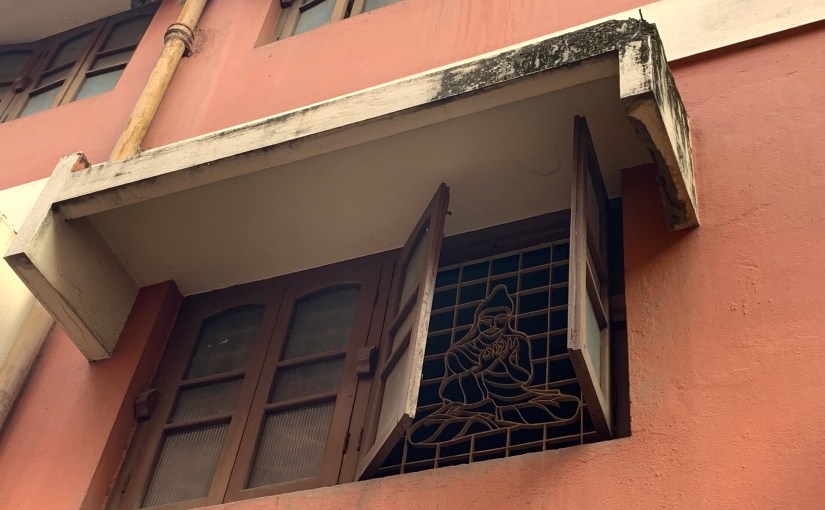
I would like to share a story of my visit to Kolkata where I was pleased to see how different religions and people from various backgrounds, can get on so well together in a close community. I believe Australia and New Zealand are very much the same.

I did a walk through an area called the grey area, the area between the white area (the British Colonials) and the black area (Indian nationals but more specifically, locals) at the time of British rule. I didn’t name these areas. That is what they were called (and still referred to in an historic discussion).

The area has a great Chinatown and mixed European influence, as well as Indian influence from areas outside West Bengal. The point is, these descendants still live and work here. They love it, and my guide, Manjit, a professional and world-renowned photographer, is there to prove it. He is a Sikh and therefore his family came originally from Punjab. He is passionate about the area and does these walking tours to show it off to tourists. (See www.calcuttaphototours.com and Instagram)

The religions that I saw on display, side by side, were Christianity, Buddhism, Judaism, Muslim and Sikhism (and of course, Hinduism which is never far away in India).

There is a beautiful Synagogue, called Maghen David, which was built in 1884 on the site of the old synagogue. Unfortunately, the remaining Jews are too few to have a rabbi. So, guess who looks after this beautiful building, on a voluntary basis – cleaning it, maintaining it, and showing people like me through it? The Muslim community!

We are all the children of the Universe or earth or God or just other humans! Whatever we believe, we’re all the same makeup. Don’t let us forget that and allow learned differences to interfere with how we get along! Let’s hope that the tragedy in New Zealand might cause a butterfly effect for good.

Peace and Amen.


New Year Fireworks and Goals

The new year has begun. 2019. It started with the explosion of fireworks, live and on the TV, the abrupt bangs and crackles heard over the low roar and whoosh of the sea, cheering voices and music. The windows were wide open, letting the heat out and the cool breeze in, and the sounds were indistinguishable, the reality from recorded.

New Year’s Eve was a quiet one for me and I couldn’t have been more content. Sharing Australian prawns, Sydney rock oysters and French champagne with an old friend. Cooking up a Thai chicken curry and eating alfresco, glad that the humidity had been washed away by the rain shower. Walking a breezy kilometre along the cliff to the park that overlooks Coogee Beach and the headland.

The fireworks at 9pm attracted families, locals and holiday-makers. The crowd was cheerful and festive. Kids had glow-sticks, parents had picnic blankets, cheeky people had sneaky drinks. Brave dogs paced next to their families, as excited as their humans. The fireworks were varied, colourful and constant for twenty minutes. Everyone seemed happy. (Presumably, those who don’t like fireworks or crowds and those whose animals are frightened, stay at home.) Fireworks were followed by a walk along the promenade and giant serves of salted caramel and double chocolate ice creams in a cone.

The simplicity and ease of the evening, along with friendship, community vibe and foodie indulgence, were what brought on the feeling of contentment. I was in a happy place. And it was the close of a big year. 2018 had its challenges: ongoing divorce proceedings, the death of my beloved chocolate Labrador, and breast cancer. But there were also many wonderful things: the road trip up the north coast to Lennox Head, the writing workshop with author, Fiona McIntosh, in SA, another road trip in Donegal, Ireland, doing research for my novel, and the completion of the first draft. All the while I had the support of caring, loving family and friends. All that deserved fireworks, and my gratitude!

So, to my goals for 2019: take better care of my body, feeding it champagne and ice cream in fewer doses; finish a polished manuscript, one good enough to present to a publisher; write every day and continue this weekly blog; maintain and enhance my relationships and give back to those who love me; have fun travelling; move house; find another dog to love; be kind, to myself as well as to others.

Considering I have a good chance of achieving my goals, I figure I have a lot to be content with. I wish you all good health, good fortune, and good goals to go after. Have a happy 2019.


Thanks to Randwick City Council https://www.randwick.nsw.gov.au/community/whats-on/coogee-sparkles and my own many blessings.


A Final Act as Master

It’s nine months since I made and enacted my last decision as master. Those of us that love dogs say our dogs are our fur-babies or our dog’s human, as if they’re our equal, but they’re not. If you’re like me, you treat your dog as your companion, a cherished member of the family or your favourite living creature on earth, but your dog is still not your equal. They’re nearer to being a dependent child or reliant best friend. As its owner, you are fully responsible for your dog’s happiness: its comfort, its health, its exercise, its mental well-being and its love. You are responsible for its life – and its death.

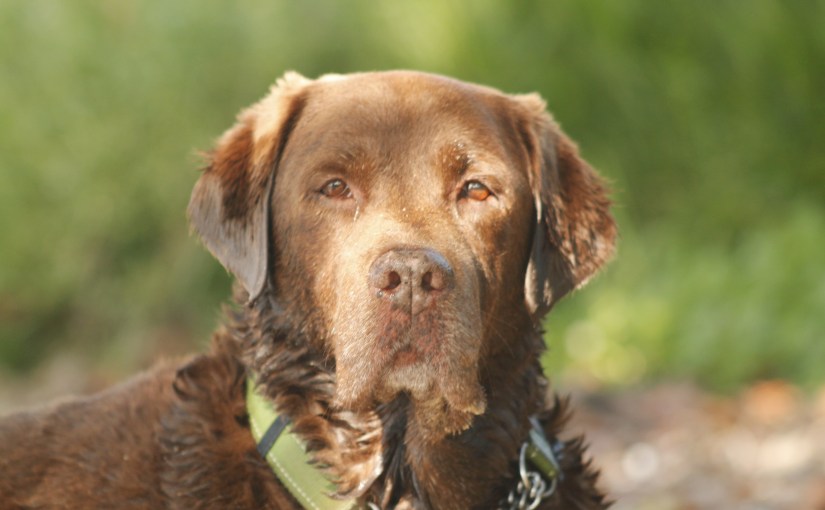
I took Chopper, my last dog, the handsome, seal-eyed, chocolate Labrador, to the vet on the afternoon of 20th March this year. I say my dog because that’s the way I felt, although I know that he had a family, my family. His two fur-brothers accompanied us. It had been a hard decision to make; harder than I knew. You see, I understood that he was suffering, and I gave him lots of drugs to ease his pain. I modified our walks and hugged him as I lay next to him on the floor. But I still thought he was happy. He always seemed eager to go out, lifting his head attentively and wagging his tail when I asked, ‘Do you want to go out?’ His eyes followed me around a room. He sat on my feet when I was still. But some days he could barely go out to wee. He could barely get up. Or he’d throw up.

My sons helped as much as they could and one day, as I broached the subject of the imminent end, they said things that indicated they already knew and they were waiting for me to accept it. I suggested we wait another week, until after the Easter break, so that Chopper and I could have quality time together in our holiday house down the south coast, a place he loved. ‘He’s still happy,’ I said, ‘so it makes it that much harder.’

Then one son said, ‘He’s not happy, he’s only happy when you’re with him.’ I was shocked. I asked the other son what he thought, and he said, ‘It’s not a dog’s life!’ I suddenly felt so sad. And selfish. My desire to keep him by my side had affected my judgement and my reality.

My sons carried him outside for his pre-bed wee, a time, not long before, we cherished as an end of day ritual: fifteen minutes walking, out in the darkness and quiet, Chopper sniffing all the night-time scents and me looking up to the moon and stars. He sat there. He couldn’t even get up to wee. I hugged him and cried. I buried my face in his furry neck and said I was sorry. I was so afraid to lose him, to no longer have the comfort of him, to be on my own.

I’d been his master for over eleven and a half years. He’d been my companion, pal and confidante. I rarely walked him on a lead. I rarely roused on him. He’d joined in the fun of the family, guarded us and looked after the emotional needs of each of us. He’d chased remote-control monster trucks, swum in the sea, supervised barbecues, romanced other dogs (putting it politely), played chasings and tug-of-war.


He’d travelled with me in a motorhome, never tiring of exploring, resting by a lake or meeting other nomads. He’d consoled me when I was sad, willed me off the lounge at night, and wagged his tail every time we made eye contact. He lay on my feet when I was writing. He didn’t feel like my equal; he felt like a soul-mate.

And for my soul-mate, I had to put his needs before my own. I had to do what I could do as his human and ultimately, his master. I could give him peace.

And nine months later, I can tell you about it.

Dec 15 (53) - Copy


Face Work

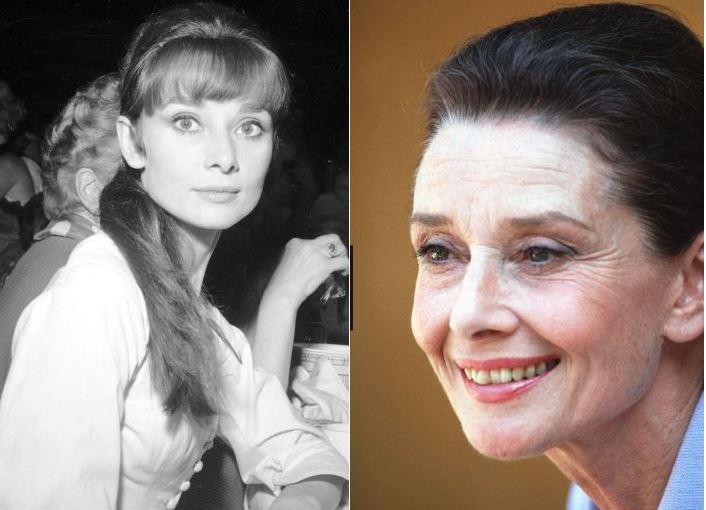
Would we love our friends more if their faces were less wrinkled, less spotted and less saggy? Would we love them more if they were ‘prettier’ or their eyebrows were higher? Would we love them more if their lips permanently pouted?

Of course not!

Loving our friends has nothing to do with how well their face defies age. It has everything to do with who they are, how they think and what their values are. We like someone when we share interests or they excite us with new ones. We like them because of how they behave, what they do and what they say. Their attention, conversation and empathy are what’s going to make us think, what a great friend, I love this friend!

Not how they look!

It’s the same the other way around. Our friends aren’t going to love us more if we have a firm, plump face. And they aren’t going to love us less for gathering grooves and sagging.

Grooming is different. Grooming is about personality. Grooming is superficial, and I don’t mean that in a derogatory sense. I mean it’s an outer layer that we can don or discard, according to how we want to present ourselves. We tend to hang around people who groom a similar way. We judge people by how they look, and that’s okay if it’s just the grooming we’re judging. It’s human nature to assess if someone is like us or not.

Some people don’t care what they look like. Some care a lot. (Some people have no choice in the matter, but they’re not who I’m talking about.) But what we wear, how we do our hair or how we decorate our faces, is just a temporary effect. It is a choice made for effect.

Don’t get me wrong. I understand the desire to stay looking younger and ‘prettier.’ In my forties, I had Botox because I was worried about my frown and drooping eyes. I didn’t like the signs of aging. But then I realised that most of my friends weren’t having Botox. They were aging naturally, and I loved them just as much. My son used to make faces at me when I laughed because he knew my face well enough to observe the distortion in my face. He loved me well enough to let me know he preferred the natural look.

I’ve noticed that it’s hard for people to stop doing ‘work’ on their faces once they start. I know that Botox leads to collagen. All that paralysing, lifting and plumping needs to continue to keep up with the aging process. And it doesn’t keep up! It twists and pulls out of shape. It leads to a false, weird look. If our friends were doing this, we’d want them to stop. We’d want our friends to stop us!

Changing our skin through use of a needle or knife reveals an insecurity. And a belief that people will love us more if we look ‘better’. My argument is that that can’t be so, that they don’t love us in the first place if they are so affected by how young or attractive we look.

We love our friends because of what’s on the inside. So lets pay more attention to that. Let’s keep our minds, our hearts and our bodies healthy. Keep learning, be curious and be interested. Be kind, compassionate and thoughtful. Eat well and be active to keep fit.

Be a good friend. Love your friend for who they are. And remember that your true friends will love you no matter how your face ages. They will love you more for the light and energy that shines through your eyes.