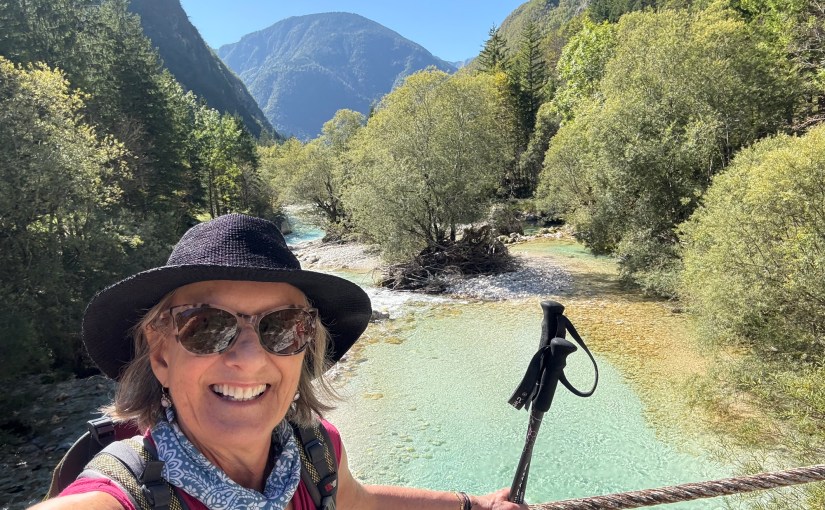
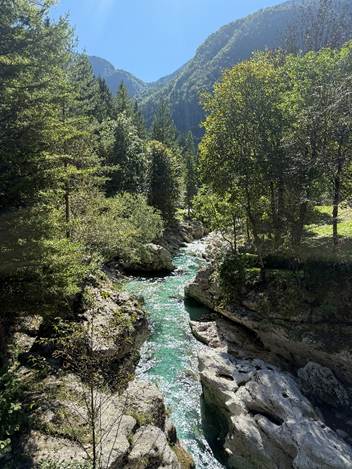
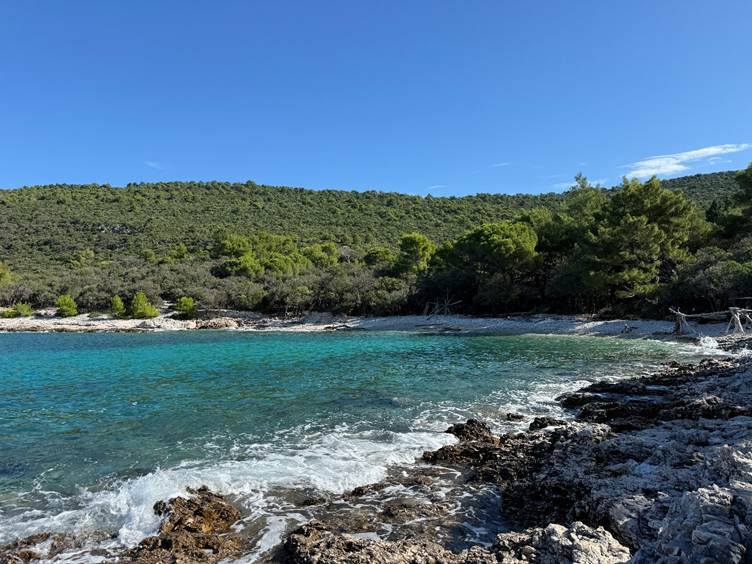
Last September I went on a trip with an all-female, hiking group through Slovenia and Croatia. It was fabulous and the scenery was even more stunning than I expected. The tour was twelve days of activity, some of them hard work, carrying our day packs and our bodies up and down mountains and along forest-dense gorges that followed rivers so glacial-green they looked almost as cold as they were. Some days were practically strolls in comparison, meanders along the Adriatic Coast where we stopped every so often to have a swim in the crystal-clear sea. It would be easy to rave about the wonders of each day, and in my last blog post I said I would. But I’ve decided there’s already enough raving out there in other blogs, documentaries and coffee-table books. The place is beautiful. If you can, go.
What I’m going to talk about are small challenges I experienced on the trip and what I learned from them.
I booked the trip a year in advance. Being a solo woman who loves travel and hiking, it was impossible to go past an ad from a company called Camino Women, a hiking group from Australia which was offering a guided multi-day hiking adventure in a region high on my bucket list. I paid a deposit quicker than I could do up my laces.
The year passed quickly, as years do, and despite torrential rain interfering with training and shonky knees getting shonkier, I was fit and packed and ready to climb mountains.
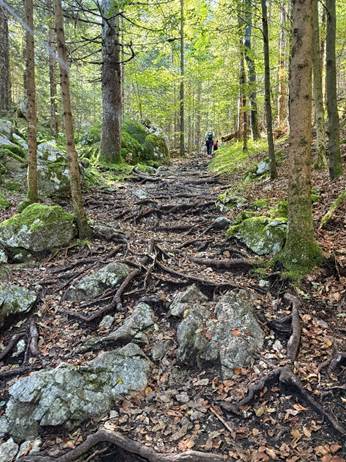
At the Meet and Greet in Ljubljana, the capital of Slovenia, the group’s two local guides led us up Rožnik Hill, ostensibly to see the view of the city but most likely to test us out. Of course, none of us wanted to be deemed slow, so all twelve middle-aged women climbed the hill at a cracking pace, clearly passing the first challenge of keeping up whilst talking. Our guides then explained that the terrain we had just experienced was a gentle taste of what was to come – tree roots, slope, loose stones and soil – and asked if we all had poles, which I didn’t. Telescopic walking aids had never been on my list and frankly, I didn’t really like them. But seeing the expression on the guides’ faces was enough to convince me I needed some before we left town. A hiking shop was found, and I chose the black carbon pair with pink lever locks for obvious aesthetic reasons.
When we set off on the first day, poles awkwardly in hands, it was wet. Lake Bled was mystically beautiful in the mist and the steep dirt track up to the lookout was slippery. I quickly learned how useful the poles were, anchoring three points (one foot, two tips) to the ground while clambering up and down ungroomed slopes. The other benefit was how much weight I could take off my knees, simply by using the strength in my upper body. I was an immediate convert.
What let me down that day was my poor choice of raincoat. Having opted to bring the lightweight one instead of my heavier, higher quality one, I was drenched by lunchtime and cold and miserable. Thankfully, that was the end of the day’s hike, and I was able to recover with a hearty hot lunch and a glass of Simčič, Slovenian red wine. Next time, though, I won’t skimp on my equipment just to save carrying a few extra grams.
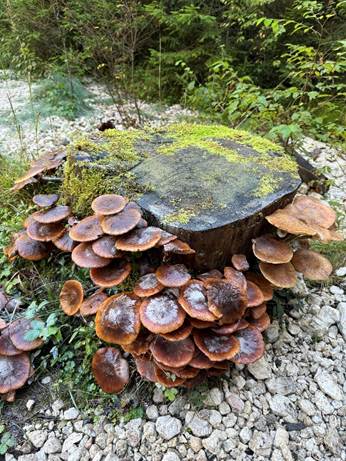
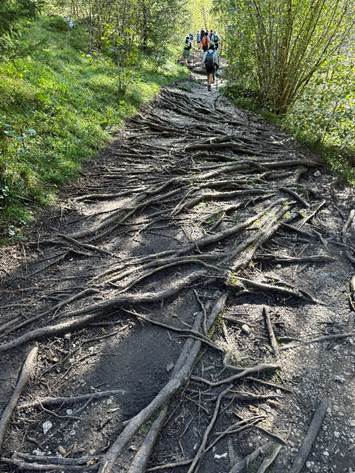
A constant challenge was the ground itself. Slovenia is predominantly limestone, a rock that can be smooth and slippery, or like shattered marbles shifting underfoot. Stones big enough to tread on can be jagged with edges like blades, and unstable. Where the soil is shallow over the limestone base, roots of trees criss-cross the track like scenes from a horror movie. Each step needed to be taken carefully and time and time again, I was grateful for my poles which saved me from tripping or twisting an ankle. Looking at the ground so much did mean having to stop to look up now and then, but even along the track there are things to admire: lichens and mosses, fungi and teeny flowers, worms and the occasional small snake. What’s right in front of you can be the best view.
Of course there were the challenges of being in a group: getting along with multiple personalities, sharing a room when you haven’t shared since you were married, being ready on time, and fitting in with a schedule. But these are the things that make group travel fun and easy too. There’s always someone to share a story with or learn from, someone who’ll lend you something you don’t have, or collaborate with when you want something different. In this group we bonded over tea. It wasn’t readily available in Slovenia (who knew that was possible?) and half of us were addicts, so finding, storing and sharing tea bags became a thing. I don’t know that would have happened in a mixed-gender group. Women know how to look after one another and are sympathetic to such critical needs. We can hunt and gather and be honest about our feelings. And particularly in a hiking group, the women are likely to be strong, uncomplaining, make-up free, and unpretentious. Certainly, this group was. Getting along was really no challenge at all.
I’d be happy to do a trip like this again. The benefits of challenges and learning aside, immersion in nature and a new culture with a bunch of purposeful, wilderness-loving women could hardly be bettered.
My poles and I became best friends and despite being chosen for their looks, they stood me in good stead right up until the end. On the last day I fell sideways on sharp rocks, and one took the brunt. As I lifted myself up and saw it snapped in two, I felt like it had sacrificed itself for me and nearly cried. A friend behind said, thank God it wasn’t your tibia. True. That would indeed have been a challenge too awful to bear.


 Carla Simmons Writer